


Description
Artists Conk (Ganoderma applanatum) — Product Summary
• 10cc liquid culture syringe containing viable Ganoderma applanatum mycelium
• Wood-decaying saprotroph — colonizes hardwood sawdust, logs, and hardwood-based substrates
• Perennial species; produces large, layered bracket fruiting bodies over multiple growing seasons
• Cultivated primarily for mycelial research, artistic applications, and ecological study
• Not a rapid-fruiting species — fruiting body development occurs over extended periods
• Store refrigerated between 35–45°F; avoid freezing
• Ships with a sterile needle; use within 4–6 months of receipt
Artists Conk (Ganoderma applanatum) Overview
Ganoderma applanatum, commonly known as Artists Conk, is a perennial wood-decaying polypore found on hardwood trees and stumps across temperate and subtropical regions worldwide. It is one of the most widely distributed bracket fungi in North America, Europe, and Asia. Artists Conk produces large, shelf-like fruiting bodies that persist and expand over multiple years, adding a new growth layer annually. The species takes its common name from the distinctive white to cream pore surface on its underside, which permanently browns when scratched or drawn upon, making it a well-known medium for natural artwork. Ganoderma applanatum is a slow-growing species relative to most cultivated fungi and is not typically grown for rapid fruiting body harvest.
Artists Conk Characteristics and Identification
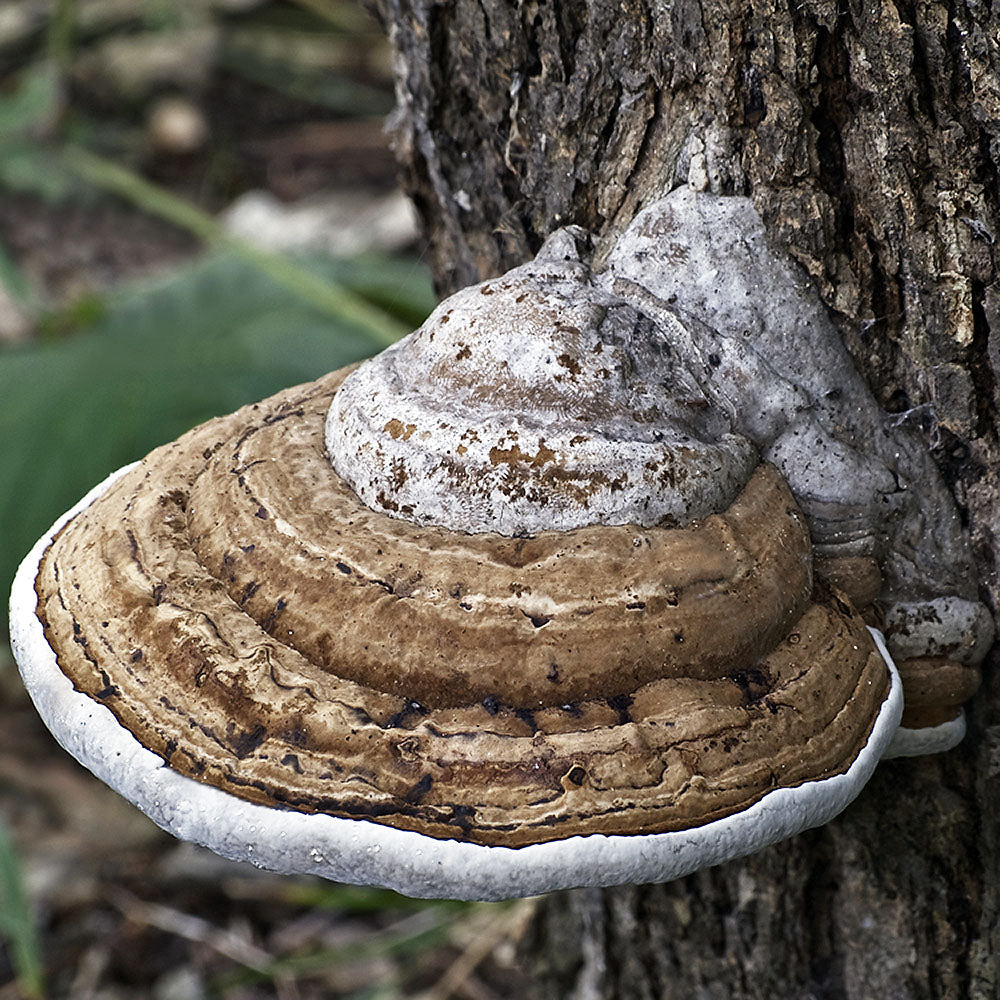
Ganoderma applanatum produces a flat to slightly convex bracket fruiting body ranging from 10 to over 60 cm in diameter, with annual specimens being considerably smaller than established perennial conks. The upper surface is gray to brown, concentrically zoned, and often covered with a fine cocoa-brown spore powder during active sporulation. The pore surface underneath is white to cream and highly reactive — light pressure from a fingernail or stylus leaves a permanent dark brown mark, a characteristic central to its use as an artistic medium. Flesh is brown, corky, and layered, with each layer representing a year of growth. Spore print is brown. Ganoderma applanatum can be distinguished from the closely related Ganoderma lucidum by its flat, non-lacquered surface and much larger mature size.
Artists Conk Habitat and Ecology
In the wild, Ganoderma applanatum grows on dead and dying hardwood trees, stumps, and buried roots across a wide range of forest types. It is particularly common on beech, oak, maple, and poplar. Artists Conk functions as both a saprotroph on dead wood and a pathogen on weakened living trees, contributing to white rot decay by breaking down lignin and cellulose in the wood substrate. The fruiting bodies are perennial and can persist on a single host for many years, releasing enormous quantities of brown basidiospores during warm months — a single large conk may release billions of spores in a season. The species is found year-round and is among the easier polypores to identify in the field due to its reactive pore surface.
Artists Conk Cultivation Considerations
Ganoderma applanatum colonizes hardwood sawdust, supplemented hardwood substrates, and hardwood logs. Mycelial colonization proceeds reliably under standard conditions but is slower than most gourmet species. Fruiting body development in cultivation is a long-term process — small bracket initials may appear after several months under appropriate conditions, but significant fruiting body development occurs over one or more growing seasons rather than weeks. Artists Conk is cultivated primarily for mycelial studies, inoculated log projects, and artistic applications rather than for regular harvest cycles. Log inoculation using plug spawn or liquid culture followed by long-term outdoor or greenhouse placement is the most practical fruiting approach for most cultivators. It responds to high humidity and moderate temperatures but does not require the precise environmental control that rapid-fruiting species demand.
Artists Conk Cultivation Parameters
|
Parameter |
Range |
|
Incubation Temperature |
65°F – 75°F |
|
Incubation Time |
30 – 60 days |
|
Fruiting Temperature |
60°F – 75°F |
|
Fruiting Humidity |
80% – 90% |
|
Bracket Initiation |
Several months to over one year |
|
Full Fruiting Body Development |
One or more growing seasons |
Artists Conk Scientific Interest
Ganoderma applanatum has been studied in the context of wood decay ecology, secondary metabolite production, and its relationship to white rot fungal communities. Like other Ganoderma species it contains polysaccharide compounds that have attracted research interest, though Ganoderma applanatum is less extensively studied than its relative Ganoderma lucidum. The species is also notable in forensic botany and dendrochronology, as the annual growth layers of established conks can be used to estimate the age of the fruiting body and the onset of host tree decline. Out-Grow makes no health claims regarding this or any other species we carry.
Artists Conk (Ganoderma applanatum) Taxonomy
• Kingdom: Fungi
• Division: Basidiomycota
• Class: Agaricomycetes
• Order: Polyporales
• Family: Ganodermataceae
• Genus: Ganoderma
• Species: Ganoderma applanatum
• Common Names: Artists Conk, Artists Bracket, Bear Bread, Flacher Lackporling
Artists Conk (Ganoderma applanatum) Liquid Culture Syringe
Description
Artists Conk (Ganoderma applanatum) — Product Summary
• 10cc liquid culture syringe containing viable Ganoderma applanatum mycelium
• Wood-decaying saprotroph — colonizes hardwood sawdust, logs, and hardwood-based substrates
• Perennial species; produces large, layered bracket fruiting bodies over multiple growing seasons
• Cultivated primarily for mycelial research, artistic applications, and ecological study
• Not a rapid-fruiting species — fruiting body development occurs over extended periods
• Store refrigerated between 35–45°F; avoid freezing
• Ships with a sterile needle; use within 4–6 months of receipt
Artists Conk (Ganoderma applanatum) Overview
Ganoderma applanatum, commonly known as Artists Conk, is a perennial wood-decaying polypore found on hardwood trees and stumps across temperate and subtropical regions worldwide. It is one of the most widely distributed bracket fungi in North America, Europe, and Asia. Artists Conk produces large, shelf-like fruiting bodies that persist and expand over multiple years, adding a new growth layer annually. The species takes its common name from the distinctive white to cream pore surface on its underside, which permanently browns when scratched or drawn upon, making it a well-known medium for natural artwork. Ganoderma applanatum is a slow-growing species relative to most cultivated fungi and is not typically grown for rapid fruiting body harvest.
Artists Conk Characteristics and Identification
Ganoderma applanatum produces a flat to slightly convex bracket fruiting body ranging from 10 to over 60 cm in diameter, with annual specimens being considerably smaller than established perennial conks. The upper surface is gray to brown, concentrically zoned, and often covered with a fine cocoa-brown spore powder during active sporulation. The pore surface underneath is white to cream and highly reactive — light pressure from a fingernail or stylus leaves a permanent dark brown mark, a characteristic central to its use as an artistic medium. Flesh is brown, corky, and layered, with each layer representing a year of growth. Spore print is brown. Ganoderma applanatum can be distinguished from the closely related Ganoderma lucidum by its flat, non-lacquered surface and much larger mature size.
Artists Conk Habitat and Ecology
In the wild, Ganoderma applanatum grows on dead and dying hardwood trees, stumps, and buried roots across a wide range of forest types. It is particularly common on beech, oak, maple, and poplar. Artists Conk functions as both a saprotroph on dead wood and a pathogen on weakened living trees, contributing to white rot decay by breaking down lignin and cellulose in the wood substrate. The fruiting bodies are perennial and can persist on a single host for many years, releasing enormous quantities of brown basidiospores during warm months — a single large conk may release billions of spores in a season. The species is found year-round and is among the easier polypores to identify in the field due to its reactive pore surface.
Artists Conk Cultivation Considerations
Ganoderma applanatum colonizes hardwood sawdust, supplemented hardwood substrates, and hardwood logs. Mycelial colonization proceeds reliably under standard conditions but is slower than most gourmet species. Fruiting body development in cultivation is a long-term process — small bracket initials may appear after several months under appropriate conditions, but significant fruiting body development occurs over one or more growing seasons rather than weeks. Artists Conk is cultivated primarily for mycelial studies, inoculated log projects, and artistic applications rather than for regular harvest cycles. Log inoculation using plug spawn or liquid culture followed by long-term outdoor or greenhouse placement is the most practical fruiting approach for most cultivators. It responds to high humidity and moderate temperatures but does not require the precise environmental control that rapid-fruiting species demand.
Artists Conk Cultivation Parameters
|
Parameter |
Range |
|
Incubation Temperature |
65°F – 75°F |
|
Incubation Time |
30 – 60 days |
|
Fruiting Temperature |
60°F – 75°F |
|
Fruiting Humidity |
80% – 90% |
|
Bracket Initiation |
Several months to over one year |
|
Full Fruiting Body Development |
One or more growing seasons |
Artists Conk Scientific Interest
Ganoderma applanatum has been studied in the context of wood decay ecology, secondary metabolite production, and its relationship to white rot fungal communities. Like other Ganoderma species it contains polysaccharide compounds that have attracted research interest, though Ganoderma applanatum is less extensively studied than its relative Ganoderma lucidum. The species is also notable in forensic botany and dendrochronology, as the annual growth layers of established conks can be used to estimate the age of the fruiting body and the onset of host tree decline. Out-Grow makes no health claims regarding this or any other species we carry.
Artists Conk (Ganoderma applanatum) Taxonomy
• Kingdom: Fungi
• Division: Basidiomycota
• Class: Agaricomycetes
• Order: Polyporales
• Family: Ganodermataceae
• Genus: Ganoderma
• Species: Ganoderma applanatum