


Description
Almond Agaricus (Agaricus subrufescens) — Product Summary
• 10cc liquid culture syringe containing viable Agaricus subrufescens mycelium
• Composting species — requires manure-based or compost substrate with a peat and lime casing layer
• Distinct almond-like aroma present in both mycelium and fruiting bodies
• Strain selected for mycelial health and fruiting consistency
• Store refrigerated between 35–45°F; avoid freezing
• Ships with a sterile needle; use within 4–6 months of receipt
Almond Agaricus (Agaricus subrufescens) Overview
Agaricus subrufescens, commonly known as Almond Agaricus, is a composting saprophyte native to North America and widely naturalized across South America, Europe, and Japan. It is closely related to Agaricus bisporus and shares the same ecological role as a decomposer of organic matter in rich, composted soils. Agaricus subrufescens is distinguished by its pronounced almond-like aroma, which is detectable in both the mycelium and mature fruiting bodies, and by the reddish-brown discoloration of its cap surface when handled or aged. The species has been cultivated in Brazil under the name Cogumelo do Sol and has a documented history of use in traditional and integrative contexts across several cultures.
Almond Agaricus Characteristics and Identification
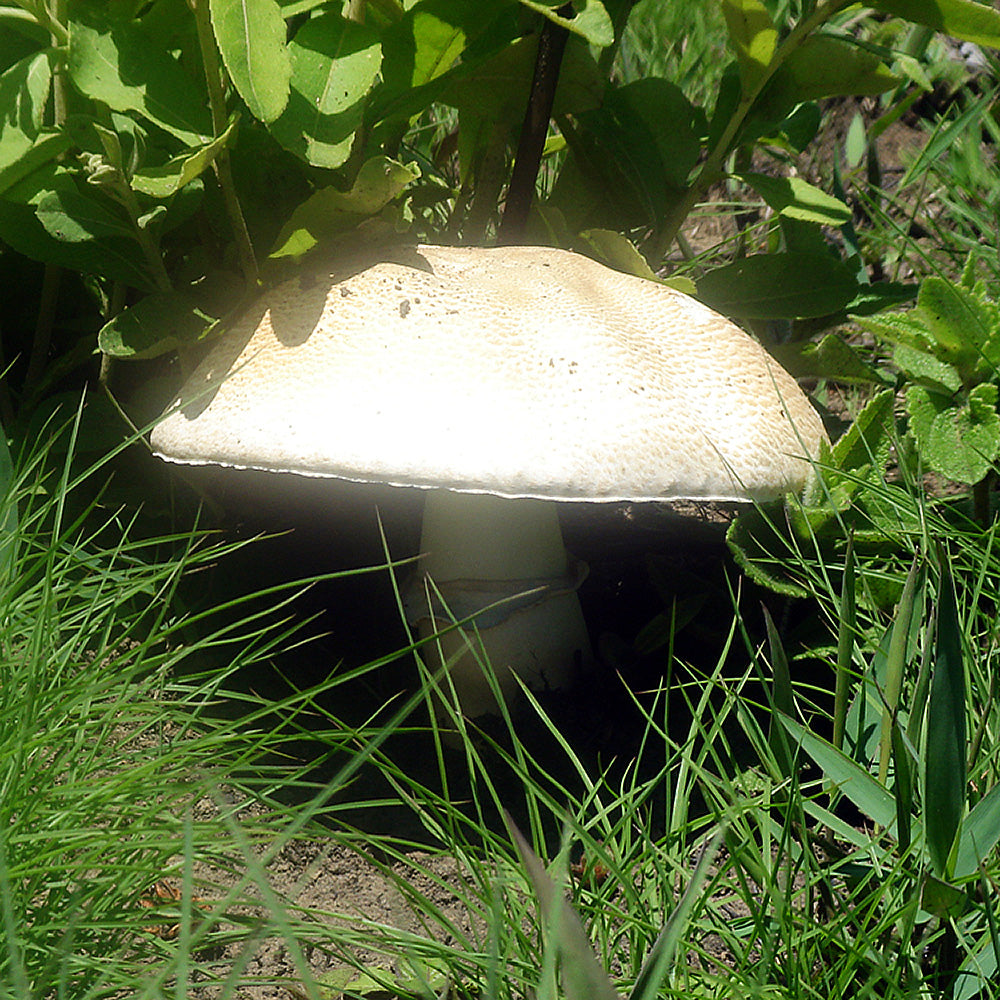
Agaricus subrufescens produces a white to pale brown cap ranging from 5 to 15 cm in diameter, smooth to slightly fibrous in texture, with surface coloration deepening to reddish-brown with handling or age. Gills are free, crowded, initially pink becoming dark chocolate brown at maturity as the spores develop. The stem is firm, white, and bears a double ring. Flesh is white, firm, and emits a distinct almond or anise-like odor. Spore print is dark brown. The species can be distinguished from toxic Agaricus species by its pleasant almond aroma rather than a phenolic or chemical odor, though confident identification should always be confirmed before consumption of wild specimens.
Almond Agaricus Habitat and Ecology
In the wild, Agaricus subrufescens grows in rich organic soils, compost heaps, garden beds, and grassy areas with high organic matter content. It is found most commonly in temperate climates during warm months and is particularly associated with nitrogen-rich environments. The species functions as a saprotroph, breaking down complex organic compounds in composted substrates. It was originally described from North America in the late 19th century and subsequently introduced to Brazil, where it became widely cultivated and is sometimes marketed under the name Royal Sun Agaricus or Himematsutake in Japanese markets.
Almond Agaricus Cultivation Considerations
Agaricus subrufescens is a composting species and does not colonize wood-based substrates. Successful cultivation requires a well-composted substrate — typically horse manure compost, straw compost, or a prepared Agaricus-style compost — followed by a casing layer of peat moss mixed with hydrated lime to buffer pH and retain moisture. This two-phase approach mirrors the cultivation method used for Agaricus bisporus. Colonization occurs in the substrate layer, while pinning is triggered by the application of the casing layer and a drop in temperature. Agaricus subrufescens prefers slightly warmer fruiting temperatures than Button or Portobello and benefits from consistent humidity and moderate fresh air exchange. It produces multiple flushes over an extended period under stable conditions.
Almond Agaricus Cultivation Parameters
|
Parameter |
Range |
|
Incubation Temperature |
75°F – 80°F |
|
Incubation Time |
14 – 28 days |
|
Fruiting Temperature |
65°F – 75°F |
|
Fruiting Humidity |
80% – 90% |
|
Pinning Time |
7 – 14 days after casing |
|
Total Fruiting Time |
21 – 35 days |
Almond Agaricus Scientific Interest
Agaricus subrufescens has been the subject of research interest, particularly in Brazil and Japan, where it has been studied for its secondary metabolite composition. Research has examined the presence of polysaccharides including beta-glucans in the fruiting body, though the clinical significance of these findings remains under active investigation. The species is also of taxonomic interest due to historical confusion with related Agaricus species, including Agaricus blazei, under which name much of the earlier research was published. Out-Grow makes no health claims regarding this or any other species we carry.
Almond Agaricus (Agaricus subrufescens) Taxonomy
• Kingdom: Fungi
• Division: Basidiomycota
• Class: Agaricomycetes
• Order: Agaricales
• Family: Agaricaceae
• Genus: Agaricus
• Species: Agaricus subrufescens
• Common Names: Almond Agaricus, Royal Sun Agaricus, Himematsutake, Cogumelo do Sol, Almond Mushroom
Almond Agaricus (Agaricus subrufescens) Liquid Culture Syringe
Product Overview
Key Features
Detailed Cultivation Guide
Storage Recommendations
Cultivation and Educational Value
Safety Information
Disclaimer
Description
Almond Agaricus (Agaricus subrufescens) — Product Summary
• 10cc liquid culture syringe containing viable Agaricus subrufescens mycelium
• Composting species — requires manure-based or compost substrate with a peat and lime casing layer
• Distinct almond-like aroma present in both mycelium and fruiting bodies
• Strain selected for mycelial health and fruiting consistency
• Store refrigerated between 35–45°F; avoid freezing
• Ships with a sterile needle; use within 4–6 months of receipt
Almond Agaricus (Agaricus subrufescens) Overview
Agaricus subrufescens, commonly known as Almond Agaricus, is a composting saprophyte native to North America and widely naturalized across South America, Europe, and Japan. It is closely related to Agaricus bisporus and shares the same ecological role as a decomposer of organic matter in rich, composted soils. Agaricus subrufescens is distinguished by its pronounced almond-like aroma, which is detectable in both the mycelium and mature fruiting bodies, and by the reddish-brown discoloration of its cap surface when handled or aged. The species has been cultivated in Brazil under the name Cogumelo do Sol and has a documented history of use in traditional and integrative contexts across several cultures.
Almond Agaricus Characteristics and Identification
Agaricus subrufescens produces a white to pale brown cap ranging from 5 to 15 cm in diameter, smooth to slightly fibrous in texture, with surface coloration deepening to reddish-brown with handling or age. Gills are free, crowded, initially pink becoming dark chocolate brown at maturity as the spores develop. The stem is firm, white, and bears a double ring. Flesh is white, firm, and emits a distinct almond or anise-like odor. Spore print is dark brown. The species can be distinguished from toxic Agaricus species by its pleasant almond aroma rather than a phenolic or chemical odor, though confident identification should always be confirmed before consumption of wild specimens.
Almond Agaricus Habitat and Ecology
In the wild, Agaricus subrufescens grows in rich organic soils, compost heaps, garden beds, and grassy areas with high organic matter content. It is found most commonly in temperate climates during warm months and is particularly associated with nitrogen-rich environments. The species functions as a saprotroph, breaking down complex organic compounds in composted substrates. It was originally described from North America in the late 19th century and subsequently introduced to Brazil, where it became widely cultivated and is sometimes marketed under the name Royal Sun Agaricus or Himematsutake in Japanese markets.
Almond Agaricus Cultivation Considerations
Agaricus subrufescens is a composting species and does not colonize wood-based substrates. Successful cultivation requires a well-composted substrate — typically horse manure compost, straw compost, or a prepared Agaricus-style compost — followed by a casing layer of peat moss mixed with hydrated lime to buffer pH and retain moisture. This two-phase approach mirrors the cultivation method used for Agaricus bisporus. Colonization occurs in the substrate layer, while pinning is triggered by the application of the casing layer and a drop in temperature. Agaricus subrufescens prefers slightly warmer fruiting temperatures than Button or Portobello and benefits from consistent humidity and moderate fresh air exchange. It produces multiple flushes over an extended period under stable conditions.
Almond Agaricus Cultivation Parameters
|
Parameter |
Range |
|
Incubation Temperature |
75°F – 80°F |
|
Incubation Time |
14 – 28 days |
|
Fruiting Temperature |
65°F – 75°F |
|
Fruiting Humidity |
80% – 90% |
|
Pinning Time |
7 – 14 days after casing |
|
Total Fruiting Time |
21 – 35 days |
Almond Agaricus Scientific Interest
Agaricus subrufescens has been the subject of research interest, particularly in Brazil and Japan, where it has been studied for its secondary metabolite composition. Research has examined the presence of polysaccharides including beta-glucans in the fruiting body, though the clinical significance of these findings remains under active investigation. The species is also of taxonomic interest due to historical confusion with related Agaricus species, including Agaricus blazei, under which name much of the earlier research was published. Out-Grow makes no health claims regarding this or any other species we carry.
Almond Agaricus (Agaricus subrufescens) Taxonomy
• Kingdom: Fungi
• Division: Basidiomycota
• Class: Agaricomycetes
• Order: Agaricales
• Family: Agaricaceae
• Genus: Agaricus
• Species: Agaricus subrufescens
• Common Names: Almond Agaricus, Royal Sun Agaricus, Himematsutake, Cogumelo do Sol, Almond Mushroom