


Description
Birch Polypore Overview
Birch Polypore (Piptoporus betulinus) is a wood-decay fungus that grows primarily on birch trees throughout temperate regions of the Northern Hemisphere. The species produces bracket-shaped fruiting bodies that develop directly from the trunks or branches of birch trees.
This fungus plays an important ecological role in forest environments by decomposing hardwood. By breaking down lignin and cellulose within birch wood, Birch Polypore contributes to nutrient recycling and the natural turnover of forest biomass.
Liquid culture allows actively growing mycelium to be maintained in a sterile nutrient solution. This form of culture can be transferred into sterilized grain spawn, agar media, or other laboratory culture systems used in mycology research and cultivation work.
Birch Polypore Characteristics and Identification
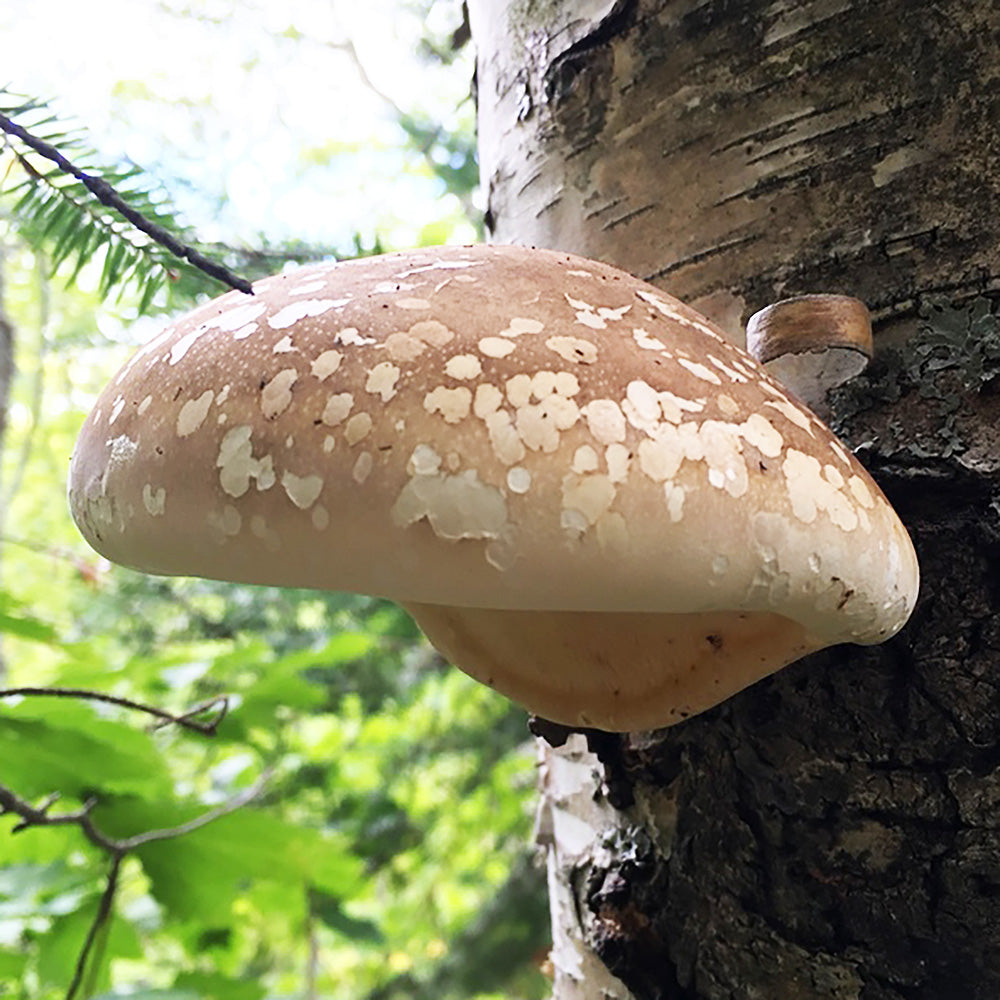
Birch Polypore produces thick, rounded fruiting bodies that resemble shelves or brackets attached to the host tree. The cap surface is usually smooth and pale tan to light brown when young. As the mushroom matures, the surface may darken or develop cracks.
The underside of the fruiting body contains a fine white pore layer rather than gills. Spores are released through these microscopic pores. The internal flesh is firm and cork-like, which allows older fruit bodies to persist on trees for long periods.
Fruiting bodies most commonly appear from late summer through autumn, although they may remain attached to the host tree well into winter.
Birch Polypore Habitat and Ecology
Piptoporus betulinus is closely associated with birch trees and is rarely found growing on other hardwood species. It commonly develops on standing dead trees, fallen logs, or weakened living birch trees.
The species functions both as a saprotrophic decomposer and as a weak parasite of stressed trees. After colonizing a host, the fungus gradually breaks down the wood through white-rot decay.
Because its life cycle is closely tied to birch hosts, the distribution of Birch Polypore generally follows the geographic range of birch forests. The species occurs widely across North America, Europe, and parts of northern Asia.
Birch Polypore Cultivation Considerations
Birch Polypore is not widely cultivated as an edible mushroom. However, it can be maintained in laboratory culture and expanded using standard mycological methods.
Liquid culture can be transferred to sterilized grain to produce spawn. The mycelium may then be introduced to hardwood substrates for experimental cultivation or research purposes.
Because the fungus is naturally adapted to birch wood, reproducing the exact ecological conditions required for fruiting can be challenging in artificial environments. For this reason, the species is most commonly studied in laboratory culture rather than grown commercially.
Scientific Interest in Birch Polypore
Birch Polypore has been studied for its historical and biochemical significance. Archaeological evidence shows that the fungus was carried by the Alpine mummy Ötzi more than 5,000 years ago, suggesting that it may have been used for medicinal or practical purposes in prehistoric cultures.
Modern research has examined compounds produced by the fungus, including polysaccharides and triterpenoids. Some laboratory studies have investigated antimicrobial and anti-inflammatory activity associated with these compounds, although additional research is required to confirm their potential applications.
Because of these characteristics, Birch Polypore continues to attract interest in fields such as fungal ecology, natural product chemistry, and ethnomycology.
Birch Polypore Taxonomy
Kingdom: Fungi
Phylum: Basidiomycota
Class: Agaricomycetes
Order: Polyporales
Family: Fomitopsidaceae
Genus: Piptoporus
Species: Piptoporus betulinus
Some modern taxonomic treatments classify the species as Fomitopsis betulina. Both names appear in scientific literature, although Piptoporus betulinus remains widely used in many mycological references.
Birch Polypore (Piptoporus betulinus) Liquid Culture Syringe
Product Overview
Key Features
Detailed Cultivation Guide
Storage Recommendations
Cultivation and Educational Value
Safety Information
Disclaimer
Description
Birch Polypore Overview
Birch Polypore (Piptoporus betulinus) is a wood-decay fungus that grows primarily on birch trees throughout temperate regions of the Northern Hemisphere. The species produces bracket-shaped fruiting bodies that develop directly from the trunks or branches of birch trees.
This fungus plays an important ecological role in forest environments by decomposing hardwood. By breaking down lignin and cellulose within birch wood, Birch Polypore contributes to nutrient recycling and the natural turnover of forest biomass.
Liquid culture allows actively growing mycelium to be maintained in a sterile nutrient solution. This form of culture can be transferred into sterilized grain spawn, agar media, or other laboratory culture systems used in mycology research and cultivation work.
Birch Polypore Characteristics and Identification
Birch Polypore produces thick, rounded fruiting bodies that resemble shelves or brackets attached to the host tree. The cap surface is usually smooth and pale tan to light brown when young. As the mushroom matures, the surface may darken or develop cracks.
The underside of the fruiting body contains a fine white pore layer rather than gills. Spores are released through these microscopic pores. The internal flesh is firm and cork-like, which allows older fruit bodies to persist on trees for long periods.
Fruiting bodies most commonly appear from late summer through autumn, although they may remain attached to the host tree well into winter.
Birch Polypore Habitat and Ecology
Piptoporus betulinus is closely associated with birch trees and is rarely found growing on other hardwood species. It commonly develops on standing dead trees, fallen logs, or weakened living birch trees.
The species functions both as a saprotrophic decomposer and as a weak parasite of stressed trees. After colonizing a host, the fungus gradually breaks down the wood through white-rot decay.
Because its life cycle is closely tied to birch hosts, the distribution of Birch Polypore generally follows the geographic range of birch forests. The species occurs widely across North America, Europe, and parts of northern Asia.
Birch Polypore Cultivation Considerations
Birch Polypore is not widely cultivated as an edible mushroom. However, it can be maintained in laboratory culture and expanded using standard mycological methods.
Liquid culture can be transferred to sterilized grain to produce spawn. The mycelium may then be introduced to hardwood substrates for experimental cultivation or research purposes.
Because the fungus is naturally adapted to birch wood, reproducing the exact ecological conditions required for fruiting can be challenging in artificial environments. For this reason, the species is most commonly studied in laboratory culture rather than grown commercially.
Scientific Interest in Birch Polypore
Birch Polypore has been studied for its historical and biochemical significance. Archaeological evidence shows that the fungus was carried by the Alpine mummy Ötzi more than 5,000 years ago, suggesting that it may have been used for medicinal or practical purposes in prehistoric cultures.
Modern research has examined compounds produced by the fungus, including polysaccharides and triterpenoids. Some laboratory studies have investigated antimicrobial and anti-inflammatory activity associated with these compounds, although additional research is required to confirm their potential applications.
Because of these characteristics, Birch Polypore continues to attract interest in fields such as fungal ecology, natural product chemistry, and ethnomycology.
Birch Polypore Taxonomy
Kingdom: Fungi
Phylum: Basidiomycota
Class: Agaricomycetes
Order: Polyporales
Family: Fomitopsidaceae
Genus: Piptoporus
Species: Piptoporus betulinus
Some modern taxonomic treatments classify the species as Fomitopsis betulina. Both names appear in scientific literature, although Piptoporus betulinus remains widely used in many mycological references.