


Description
What is the Blewit Mushroom?
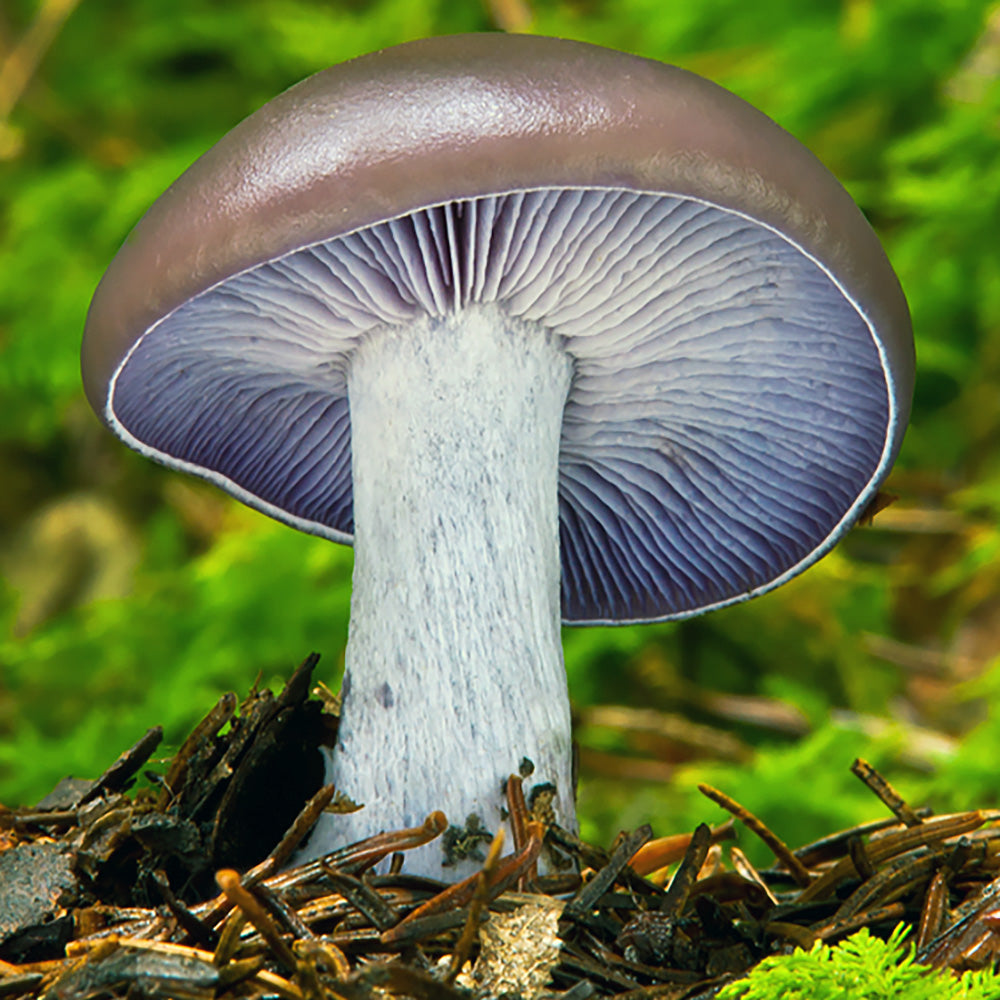
The Blewit Mushroom (Lepista nuda), also known as the Wood Blewit, is a distinctive saprotrophic agaric native to Europe and North America, recognized by its vivid violet-blue coloration throughout the cap, gills, and stem when young. The name "blewit" is derived from "blue hat" — an old English forager's term that has stayed in use for centuries. It is one of the more reliably identifiable wild mushrooms, and one of the few violet-colored species considered a good edible.
Lepista nuda is fully cultivable without a living host tree. Unlike ectomycorrhizal species, it decomposes dead organic matter and can be fruited on compost-based substrates — a distinction that makes it genuinely accessible for home and commercial cultivation. Peer-reviewed trials have documented biological efficiency of 35–50% on well-prepared compost, with performance highly dependent on strain selection.
Where Does Lepista nuda Grow?
The Blewit Mushroom (Lepista nuda) grows in broadleaf and mixed woodland, hedgerows, gardens, compost heaps, and open ground where decomposing organic matter accumulates. It is particularly associated with leaf litter under beech, oak, and mixed hedgerow. Fruiting occurs from late autumn into early winter — later in the season than most other agarics — and the species tolerates near-freezing temperatures that stop most mushrooms. It commonly forms fairy rings or arcing clusters. Distribution spans Europe, North America, and parts of Asia and Australia.
Cultivation Specifics
Blewit Mushroom cultivation requires compost-based substrates rather than simple sterilized grain or straw — it behaves similarly to button mushrooms (Agaricus bisporus) in needing a prepared compost bed and a casing layer to initiate fruiting. Optimal mycelial growth occurs at 20–25°C; fruiting is triggered by cooling to 12–18°C with 90–95% relative humidity. A 2–3 cm casing layer of sandy soil or peat is essential for pin formation.
The violet coloration of both mycelium and fruiting bodies is a useful indicator of culture health — vibrant purple tones on agar suggest a strong, uncontaminated culture. Pale or browning mycelium warrants inspection. As with all blewits, thorough cooking is required before consumption; raw specimens can cause digestive upset.
Identification Notes
The most important lookalike risk is confusion with violet Cortinarius species, some of which are seriously toxic. Key separators: Blewit Mushroom has a pale pinkish-cream to buff spore print (never rusty brown), no cobweb cortina veil, and a distinctly pleasant, perfumed or floral scent rather than a radish-like or earthy smell. Always take a spore print before consuming any violet-toned mushroom.
Taxonomic Details for Lepista nuda
- Kingdom: Fungi
- Division: Basidiomycota
- Class: Agaricomycetes
- Order: Agaricales
- Family: Tricholomataceae
- Genus: Lepista
- Species: Lepista nuda
Blewit Mushroom (Lepista nuda) Liquid Culture Syringe
Product Overview
Key Features
Detailed Cultivation Guide
Storage Recommendations
Cultivation and Educational Value
Safety Information
Disclaimer
Description
What is the Blewit Mushroom?
The Blewit Mushroom (Lepista nuda), also known as the Wood Blewit, is a distinctive saprotrophic agaric native to Europe and North America, recognized by its vivid violet-blue coloration throughout the cap, gills, and stem when young. The name "blewit" is derived from "blue hat" — an old English forager's term that has stayed in use for centuries. It is one of the more reliably identifiable wild mushrooms, and one of the few violet-colored species considered a good edible.
Lepista nuda is fully cultivable without a living host tree. Unlike ectomycorrhizal species, it decomposes dead organic matter and can be fruited on compost-based substrates — a distinction that makes it genuinely accessible for home and commercial cultivation. Peer-reviewed trials have documented biological efficiency of 35–50% on well-prepared compost, with performance highly dependent on strain selection.
Where Does Lepista nuda Grow?
The Blewit Mushroom (Lepista nuda) grows in broadleaf and mixed woodland, hedgerows, gardens, compost heaps, and open ground where decomposing organic matter accumulates. It is particularly associated with leaf litter under beech, oak, and mixed hedgerow. Fruiting occurs from late autumn into early winter — later in the season than most other agarics — and the species tolerates near-freezing temperatures that stop most mushrooms. It commonly forms fairy rings or arcing clusters. Distribution spans Europe, North America, and parts of Asia and Australia.
Cultivation Specifics
Blewit Mushroom cultivation requires compost-based substrates rather than simple sterilized grain or straw — it behaves similarly to button mushrooms (Agaricus bisporus) in needing a prepared compost bed and a casing layer to initiate fruiting. Optimal mycelial growth occurs at 20–25°C; fruiting is triggered by cooling to 12–18°C with 90–95% relative humidity. A 2–3 cm casing layer of sandy soil or peat is essential for pin formation.
The violet coloration of both mycelium and fruiting bodies is a useful indicator of culture health — vibrant purple tones on agar suggest a strong, uncontaminated culture. Pale or browning mycelium warrants inspection. As with all blewits, thorough cooking is required before consumption; raw specimens can cause digestive upset.
Identification Notes
The most important lookalike risk is confusion with violet Cortinarius species, some of which are seriously toxic. Key separators: Blewit Mushroom has a pale pinkish-cream to buff spore print (never rusty brown), no cobweb cortina veil, and a distinctly pleasant, perfumed or floral scent rather than a radish-like or earthy smell. Always take a spore print before consuming any violet-toned mushroom.
Taxonomic Details for Lepista nuda
- Kingdom: Fungi
- Division: Basidiomycota
- Class: Agaricomycetes
- Order: Agaricales
- Family: Tricholomataceae
- Genus: Lepista
- Species: Lepista nuda