


Description
Blue Oyster Mushroom (Pleurotus columbinus) — Product Summary
• 10cc liquid culture syringe containing viable Pleurotus columbinus mycelium
• Cold-tolerant oyster variety — fruits at lower temperatures than most Pleurotus species
• Steel-blue to gray caps that lighten to tan at maturity
• Suitable for straw, hardwood sawdust, and supplemented hardwood substrates
• Vigorous colonizer with dense cluster formation during fruiting
• Store refrigerated between 35–45°F; avoid freezing
• Ships with a sterile needle; use within 4–6 months of receipt
Blue Oyster Mushroom (Pleurotus columbinus) Overview
Pleurotus columbinus, commonly known as Blue Oyster or Blue Pearl Oyster, is a cold-tolerant variety within the Pleurotus genus characterized by its distinctive steel-blue to gray cap coloration. While closely related to Pleurotus ostreatus, Blue Oyster exhibits distinct fruiting characteristics that make it well suited to cooler growing environments and late autumn or winter cultivation cycles. The species produces medium to large fan-shaped caps that display the most pronounced blue coloration at lower temperatures and in reduced light conditions. Pleurotus columbinus is among the more vigorous colonizers in the oyster mushroom group and responds well to a variety of lignocellulosic substrates, making it a reliable choice for cultivators working in temperature-variable or cooler environments.
Blue Oyster Mushroom Characteristics and Identification
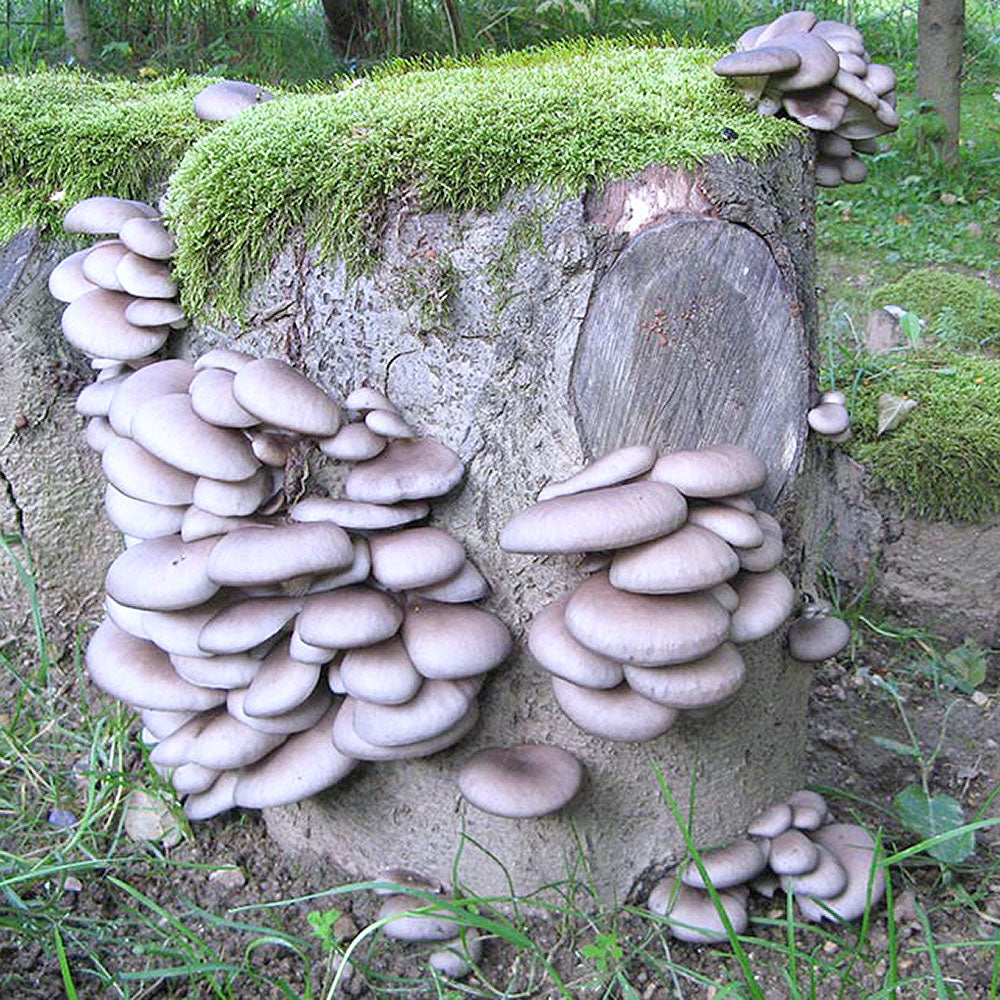
Pleurotus columbinus produces fan-shaped caps ranging from 5 to 15 cm across, with colors ranging from deep steel-blue to gray-blue when young, lightening to tan or beige at maturity or in higher temperature conditions. Gills are white to cream, decurrent, and run down a short, off-center stem. The blue coloration is most vibrant in fresh, young specimens and is enhanced by cool temperatures and lower light levels. Flesh is white, firm, and mild in flavor. Spore print is white to pale lilac. Cap color variability makes visual identification somewhat challenging, as warmer temperatures and bright light can cause the blue tones to fade significantly, making specimens appear similar to standard Pearl Oyster.
Blue Oyster Mushroom Habitat and Ecology
In the wild, Pleurotus columbinus grows on dead hardwood logs, stumps, and branches, with a particular association with deciduous trees in temperate forest regions. The species is distributed across temperate zones of North America, Europe, and Asia, often overlapping geographically with Pleurotus ostreatus but occupying cooler microhabitat niches. Blue Oyster fruits predominantly during cooler months of autumn and winter, when ambient temperatures drop below the comfort range of warm-season oyster varieties. This cold-season fruiting window reduces competition with other Pleurotus species and allows the variety to exploit available substrate resources when other wood decomposers are less active.
Blue Oyster Mushroom Cultivation Considerations
Pleurotus columbinus colonizes straw, hardwood sawdust, and supplemented hardwood substrates effectively and is compatible with standard oyster mushroom cultivation techniques. The variety excels in cooler growing environments and is particularly well suited to unheated growing spaces during autumn and winter months. Fruiting is initiated by high humidity, fresh air exchange, and temperature drops into the 45–65°F range. Blue Oyster benefits from strong air exchange during fruiting to prevent excessive stem elongation and to encourage dense cluster formation. The species produces multiple flushes from a single substrate block and maintains productivity across a broader temperature range than most cold-sensitive varieties.
Blue Oyster Mushroom Cultivation Parameters
|
Parameter |
Range |
|
Incubation Temperature |
70°F – 77°F |
|
Incubation Time |
10 – 16 days |
|
Fruiting Temperature |
45°F – 65°F |
|
Fruiting Humidity |
85% – 95% |
|
Pinning Time |
5 – 10 days |
|
Total Fruiting Time |
10 – 18 days |
Blue Oyster Mushroom Scientific Interest
Pleurotus columbinus is of interest in the context of cold adaptation in fungi, particularly the physiological and biochemical mechanisms that enable low-temperature fruiting in the Pleurotus genus. The blue pigmentation has been studied in relation to environmental stress responses and may be linked to antioxidant compound production under cool, humid conditions. Research into temperature-dependent gene expression in oyster mushrooms has used cold-tolerant varieties like Blue Oyster as model systems for understanding thermal adaptation in wood-decay fungi. The variety is also relevant to sustainable agriculture research focused on extending growing seasons and reducing energy inputs in mushroom production systems.
Blue Oyster Mushroom (Pleurotus columbinus) Taxonomy
• Kingdom: Fungi
• Division: Basidiomycota
• Class: Agaricomycetes
• Order: Agaricales
• Family: Pleurotaceae
• Genus: Pleurotus
• Species: Pleurotus columbinus
• Common Names: Blue Oyster, Blue Pearl Oyster, Steel Blue Oyster
Blue Oyster Mushroom (Pleurotus columbinus) Liquid Culture Syringe
Product Overview
Key Features
Detailed Cultivation Guide
Storage Recommendations
Cultivation and Educational Value
Safety Information
Disclaimer
Description
Blue Oyster Mushroom (Pleurotus columbinus) — Product Summary
• 10cc liquid culture syringe containing viable Pleurotus columbinus mycelium
• Cold-tolerant oyster variety — fruits at lower temperatures than most Pleurotus species
• Steel-blue to gray caps that lighten to tan at maturity
• Suitable for straw, hardwood sawdust, and supplemented hardwood substrates
• Vigorous colonizer with dense cluster formation during fruiting
• Store refrigerated between 35–45°F; avoid freezing
• Ships with a sterile needle; use within 4–6 months of receipt
Blue Oyster Mushroom (Pleurotus columbinus) Overview
Pleurotus columbinus, commonly known as Blue Oyster or Blue Pearl Oyster, is a cold-tolerant variety within the Pleurotus genus characterized by its distinctive steel-blue to gray cap coloration. While closely related to Pleurotus ostreatus, Blue Oyster exhibits distinct fruiting characteristics that make it well suited to cooler growing environments and late autumn or winter cultivation cycles. The species produces medium to large fan-shaped caps that display the most pronounced blue coloration at lower temperatures and in reduced light conditions. Pleurotus columbinus is among the more vigorous colonizers in the oyster mushroom group and responds well to a variety of lignocellulosic substrates, making it a reliable choice for cultivators working in temperature-variable or cooler environments.
Blue Oyster Mushroom Characteristics and Identification
Pleurotus columbinus produces fan-shaped caps ranging from 5 to 15 cm across, with colors ranging from deep steel-blue to gray-blue when young, lightening to tan or beige at maturity or in higher temperature conditions. Gills are white to cream, decurrent, and run down a short, off-center stem. The blue coloration is most vibrant in fresh, young specimens and is enhanced by cool temperatures and lower light levels. Flesh is white, firm, and mild in flavor. Spore print is white to pale lilac. Cap color variability makes visual identification somewhat challenging, as warmer temperatures and bright light can cause the blue tones to fade significantly, making specimens appear similar to standard Pearl Oyster.
Blue Oyster Mushroom Habitat and Ecology
In the wild, Pleurotus columbinus grows on dead hardwood logs, stumps, and branches, with a particular association with deciduous trees in temperate forest regions. The species is distributed across temperate zones of North America, Europe, and Asia, often overlapping geographically with Pleurotus ostreatus but occupying cooler microhabitat niches. Blue Oyster fruits predominantly during cooler months of autumn and winter, when ambient temperatures drop below the comfort range of warm-season oyster varieties. This cold-season fruiting window reduces competition with other Pleurotus species and allows the variety to exploit available substrate resources when other wood decomposers are less active.
Blue Oyster Mushroom Cultivation Considerations
Pleurotus columbinus colonizes straw, hardwood sawdust, and supplemented hardwood substrates effectively and is compatible with standard oyster mushroom cultivation techniques. The variety excels in cooler growing environments and is particularly well suited to unheated growing spaces during autumn and winter months. Fruiting is initiated by high humidity, fresh air exchange, and temperature drops into the 45–65°F range. Blue Oyster benefits from strong air exchange during fruiting to prevent excessive stem elongation and to encourage dense cluster formation. The species produces multiple flushes from a single substrate block and maintains productivity across a broader temperature range than most cold-sensitive varieties.
Blue Oyster Mushroom Cultivation Parameters
|
Parameter |
Range |
|
Incubation Temperature |
70°F – 77°F |
|
Incubation Time |
10 – 16 days |
|
Fruiting Temperature |
45°F – 65°F |
|
Fruiting Humidity |
85% – 95% |
|
Pinning Time |
5 – 10 days |
|
Total Fruiting Time |
10 – 18 days |
Blue Oyster Mushroom Scientific Interest
Pleurotus columbinus is of interest in the context of cold adaptation in fungi, particularly the physiological and biochemical mechanisms that enable low-temperature fruiting in the Pleurotus genus. The blue pigmentation has been studied in relation to environmental stress responses and may be linked to antioxidant compound production under cool, humid conditions. Research into temperature-dependent gene expression in oyster mushrooms has used cold-tolerant varieties like Blue Oyster as model systems for understanding thermal adaptation in wood-decay fungi. The variety is also relevant to sustainable agriculture research focused on extending growing seasons and reducing energy inputs in mushroom production systems.
Blue Oyster Mushroom (Pleurotus columbinus) Taxonomy
• Kingdom: Fungi
• Division: Basidiomycota
• Class: Agaricomycetes
• Order: Agaricales
• Family: Pleurotaceae
• Genus: Pleurotus
• Species: Pleurotus columbinus
• Common Names: Blue Oyster, Blue Pearl Oyster, Steel Blue Oyster