


Description
What is the Gem Studded Puffball?
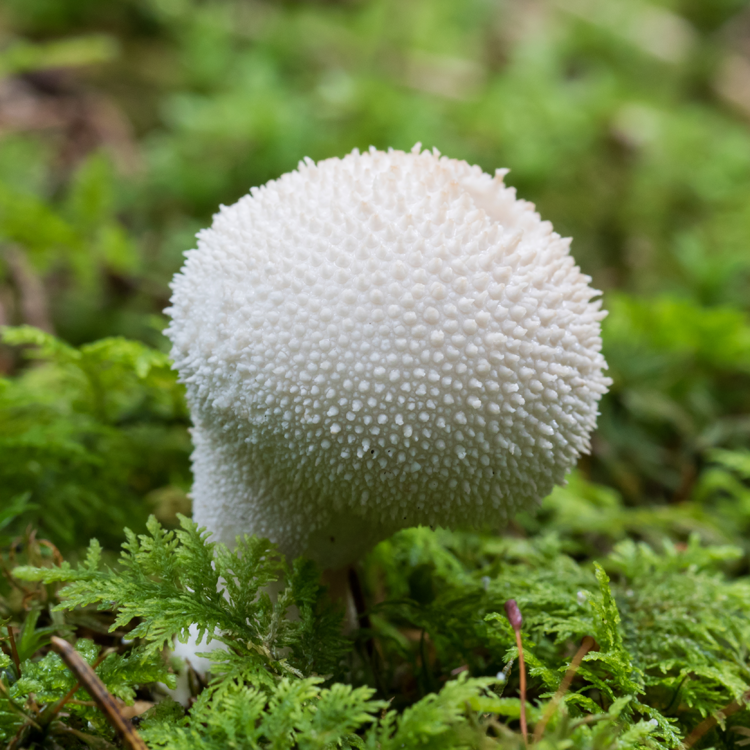
The Gem Studded Puffball (Lycoperdon perlatum) is one of the most recognizable puffball mushrooms in the world, named for the small, conical spines that cover its surface like a cluster of gems or studs. These spines eventually fall away as the fruiting body matures, leaving behind a characteristic patterned surface. Found across meadows, woodlands, and forest edges throughout North America, Europe, and Asia, it is among the most commonly encountered puffballs for foragers and naturalists alike.
When young and white throughout, the Gem Studded Puffball is considered edible — a good food mushroom with a mild, earthy flavor. As it matures, the interior turns yellow, then olive-brown, and finally develops into a dry powdery mass of spores. At that stage it is no longer edible but becomes a remarkable natural spectacle, releasing spores in puffs of brown cloud when disturbed.
Where Does Lycoperdon perlatum Grow?
Lycoperdon perlatum is a saprotrophic fungus, growing on decaying organic matter in soil. It is found across temperate regions of the Northern Hemisphere — appearing in grasslands, pastures, mixed and deciduous woodlands, forest margins, roadsides, and disturbed ground. It typically fruits from late summer through autumn, often appearing in scattered groups or clusters. It is one of the widest-ranging puffball species, recorded from North America, Europe, Asia, and parts of South America and Australia.
Identification and Key Characteristics
The fruiting body is typically 2–6 cm tall and 1.5–4.5 cm wide — pear-shaped to club-shaped with a distinct narrowed sterile base. The defining feature in young specimens is the covering of tall conical spines (up to 4mm), each surrounded by a ring of smaller spines. As the mushroom ages, these spines break off, leaving a net-like scar pattern on the surface that is diagnostic for the species. The interior flesh is pure white and firm when young — this is the edible stage. A small apical pore develops at the top of mature specimens through which spores are released.
Always cross-section any puffball before eating. The interior must be pure white and uniformly structureless — any sign of yellow coloration, internal gills, or a developing cap outline indicates the mushroom is past its edible stage or is not a true puffball.
Cultivation and Liquid Culture Use
Like all puffballs, Lycoperdon perlatum does not have an established indoor fruiting protocol. Puffball cultivation remains one of the least solved challenges in applied mycology — these species require specific soil conditions, microbiome interactions, and seasonal triggers that are not easily replicated in controlled settings. The most documented approach is outdoor bed inoculation: establishing mycelium in humus-rich, well-draining garden soil and allowing natural seasonal conditions to trigger fruiting.
This liquid culture contains clean, viable Lycoperdon perlatum mycelium suitable for agar work, grain spawn production for outdoor bed trials, mycelial biomass research, and culture collection maintenance.
Taxonomic Details for Lycoperdon perlatum
- Kingdom: Fungi
- Division: Basidiomycota
- Class: Agaricomycetes
- Order: Agaricales
- Family: Agaricaceae
- Genus: Lycoperdon
- Species: Lycoperdon perlatum
Gem Studded Puffball (Lycoperdon perlatum) Liquid Culture Syringe
Description
What is the Gem Studded Puffball?
The Gem Studded Puffball (Lycoperdon perlatum) is one of the most recognizable puffball mushrooms in the world, named for the small, conical spines that cover its surface like a cluster of gems or studs. These spines eventually fall away as the fruiting body matures, leaving behind a characteristic patterned surface. Found across meadows, woodlands, and forest edges throughout North America, Europe, and Asia, it is among the most commonly encountered puffballs for foragers and naturalists alike.
When young and white throughout, the Gem Studded Puffball is considered edible — a good food mushroom with a mild, earthy flavor. As it matures, the interior turns yellow, then olive-brown, and finally develops into a dry powdery mass of spores. At that stage it is no longer edible but becomes a remarkable natural spectacle, releasing spores in puffs of brown cloud when disturbed.
Where Does Lycoperdon perlatum Grow?
Lycoperdon perlatum is a saprotrophic fungus, growing on decaying organic matter in soil. It is found across temperate regions of the Northern Hemisphere — appearing in grasslands, pastures, mixed and deciduous woodlands, forest margins, roadsides, and disturbed ground. It typically fruits from late summer through autumn, often appearing in scattered groups or clusters. It is one of the widest-ranging puffball species, recorded from North America, Europe, Asia, and parts of South America and Australia.
Identification and Key Characteristics
The fruiting body is typically 2–6 cm tall and 1.5–4.5 cm wide — pear-shaped to club-shaped with a distinct narrowed sterile base. The defining feature in young specimens is the covering of tall conical spines (up to 4mm), each surrounded by a ring of smaller spines. As the mushroom ages, these spines break off, leaving a net-like scar pattern on the surface that is diagnostic for the species. The interior flesh is pure white and firm when young — this is the edible stage. A small apical pore develops at the top of mature specimens through which spores are released.
Always cross-section any puffball before eating. The interior must be pure white and uniformly structureless — any sign of yellow coloration, internal gills, or a developing cap outline indicates the mushroom is past its edible stage or is not a true puffball.
Cultivation and Liquid Culture Use
Like all puffballs, Lycoperdon perlatum does not have an established indoor fruiting protocol. Puffball cultivation remains one of the least solved challenges in applied mycology — these species require specific soil conditions, microbiome interactions, and seasonal triggers that are not easily replicated in controlled settings. The most documented approach is outdoor bed inoculation: establishing mycelium in humus-rich, well-draining garden soil and allowing natural seasonal conditions to trigger fruiting.
This liquid culture contains clean, viable Lycoperdon perlatum mycelium suitable for agar work, grain spawn production for outdoor bed trials, mycelial biomass research, and culture collection maintenance.
Taxonomic Details for Lycoperdon perlatum
- Kingdom: Fungi
- Division: Basidiomycota
- Class: Agaricomycetes
- Order: Agaricales
- Family: Agaricaceae
- Genus: Lycoperdon
- Species: Lycoperdon perlatum