


Description
About This Mushroom Liquid Culture
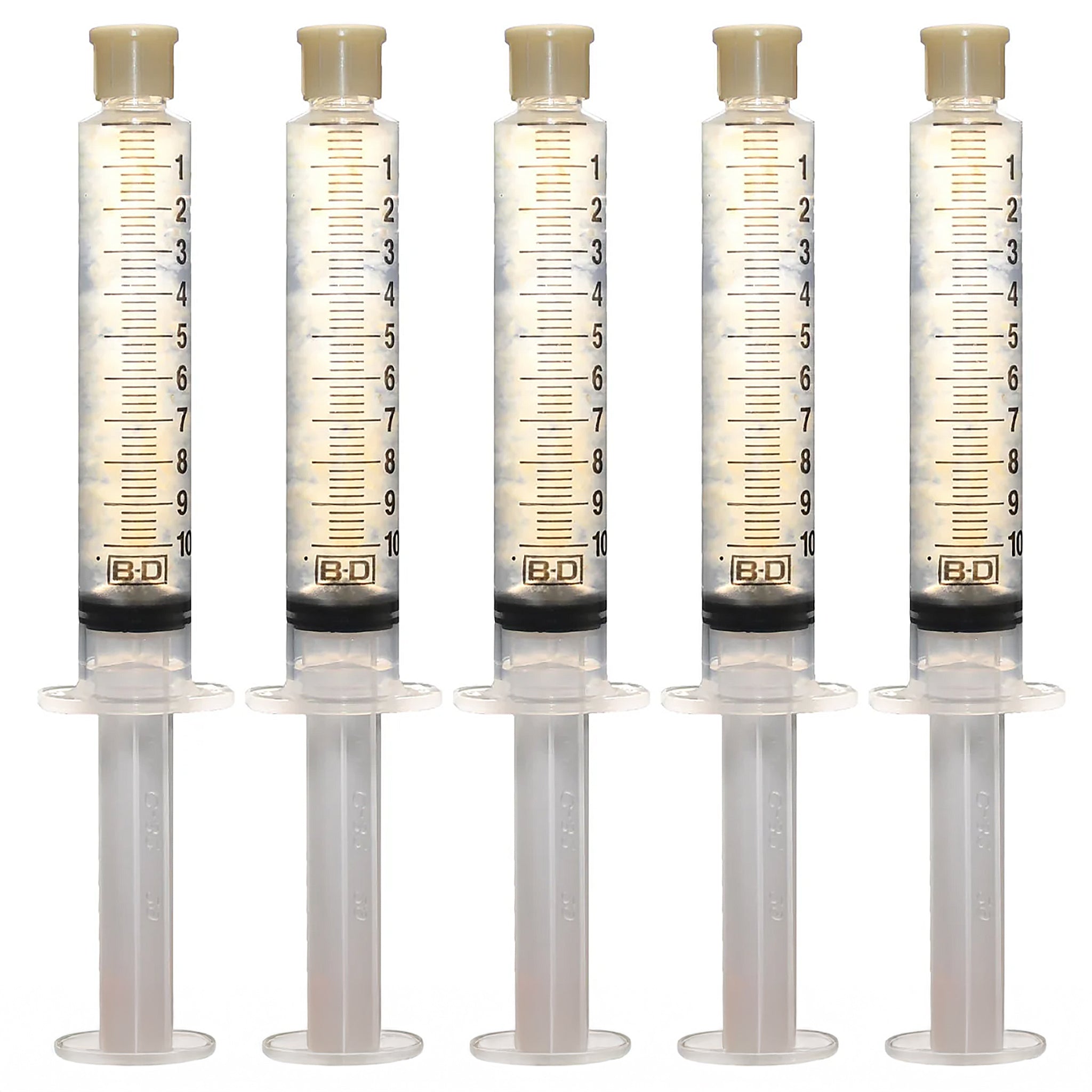
Our Honey Mushroom 4 Pack is a premium mushroom liquid culture: live, lab-verified mycelium suspended in sterile nutrient broth and ready to inoculate your grow medium. Each set ships with sterile needles for clean, reliable transfers.
Honey Mushroom Liquid Culture 4 Pack — Product Summary
- Four 10–12cc liquid culture syringes of distinct Honey Mushroom species and varieties
- Includes: Honey Mushroom (Armillaria mellea), Bulbous Honey (Armillaria gallica), Armillaria nabsnona, Ringless Honey (Desarmillaria caespitosa)
- Each syringe contains viable mycelium in sterile nutrient broth
- Store liquid culture syringes at normal room temperature in the original packaging for 6 or more months.
- Ships with sterile needles
Honey Mushroom Liquid Culture 4 Pack — Pack Overview
The Honey Mushroom Cultures 4 Pack brings together four species in the Armillaria and Desarmillaria genera, the honey mushrooms that are among the most widely eaten wild edibles in Europe and the most ecologically significant wood-decay fungi in temperate forests. Here is the part that stops people: the individual organism of Armillaria ostoyae known as the Humongous Fungus in the Malheur National Forest in Oregon is estimated to cover over 2,000 acres and weigh in the millions of pounds. It is considered the largest individual organism on earth. Honey mushrooms are fascinating in ways that go well beyond their table value, and this pack gives cultivators access to the full range of the genus in verified liquid culture form.
Honey Mushroom Liquid Culture 4 Pack — Included Species
Honey Mushroom (Armillaria mellea) Liquid Culture
Armillaria mellea is the classic honey mushroom, the golden-capped, ring-stemmed Armillaria that grows in dense clusters at the base of hardwood stumps and on buried roots in late summer and fall. It is one of the most widely consumed wild edible mushrooms in Europe, where it is preserved and pickled in enormous quantities each autumn. It is also a significant wood pathogen, spreading through forest soil via black rhizomorphs that look like bootlaces and infect living and dead hardwood roots. Cultivating it from liquid culture involves supplemented hardwood substrate and produces the same dense clusters foragers know from wild harvest.
Honey Mushroom — Out-Grow Lab Notes
| Parameter | Out-Grow Notes |
| Culture medium | LME + dextrose, 2% + 2% in distilled water |
| Substrate | Supplemented hardwood sawdust; hardwood logs and stumps |
| Growth habit | Dense clusters at substrate base — characteristic of the genus |
| Edible status | Widely eaten in Europe; must be thoroughly cooked |
| Inoculation rate | 2 to 3cc per quart of sterilized grain or hardwood substrate |
| Storage life | 6 or more months at normal room temperature |
Honey Mushroom Taxonomy
- Kingdom: Fungi
- Division: Basidiomycota
- Class: Agaricomycetes
- Order: Agaricales
- Family: Physalacriaceae
- Genus: Armillaria
- Species: Armillaria mellea
Bulbous Honey (Armillaria gallica) Liquid Culture
Armillaria gallica is the honey mushroom species most likely to be what you find in eastern North American forests, and the one connected to some of the largest single-organism discoveries in mycology. A single A. gallica clone in a Michigan forest was estimated to be over 1,500 years old and spread across 37 acres. The bulbous base of the stem, the gallica of the species name, is the easy identification character. It behaves similarly to A. mellea in cultivation and produces edible clusters of good quality.
Bulbous Honey — Out-Grow Lab Notes
| Parameter | Out-Grow Notes |
| Culture medium | LME + dextrose, 2% + 2% in distilled water |
| Substrate | Supplemented hardwood sawdust; hardwood substrate |
| Identification | Bulbous stem base — characteristic of this species |
| Notable | Single clones documented at 1,500+ years old and 37 acres in Michigan |
| Inoculation rate | 2 to 3cc per quart of sterilized grain or hardwood substrate |
| Storage life | 6 or more months at normal room temperature |
Bulbous Honey Taxonomy
- Kingdom: Fungi
- Division: Basidiomycota
- Class: Agaricomycetes
- Order: Agaricales
- Family: Physalacriaceae
- Genus: Armillaria
- Species: Armillaria gallica
Armillaria nabsnona Liquid Culture
Armillaria nabsnona is one of the less commonly discussed North American Armillaria species, occupying a range in the Pacific Northwest and British Columbia and associated with conifers in that region. It is a genuine rarity in the cultivation market and we carry it for the same reason we carry the full range of any genus we work with, because complete collections matter and because researchers and serious cultivators working with Armillaria should have access to the full range of North American species.
Armillaria nabsnona — Out-Grow Lab Notes
| Parameter | Out-Grow Notes |
| Culture medium | LME + dextrose, 2% + 2% in distilled water |
| Range | Pacific Northwest and British Columbia — associated with conifers |
| Rarity | Rarely available in liquid culture format outside research contexts |
| Inoculation rate | 2 to 3cc per quart of sterilized grain or hardwood substrate |
| Storage life | 6 or more months at normal room temperature |
Armillaria nabsnona Taxonomy
- Kingdom: Fungi
- Division: Basidiomycota
- Class: Agaricomycetes
- Order: Agaricales
- Family: Physalacriaceae
- Genus: Armillaria
- Species: Armillaria nabsnona
Ringless Honey (Desarmillaria caespitosa) Liquid Culture
Ringless Honey is the honey mushroom that grows without the characteristic ring on the stem, the annulus that identifies most Armillaria species. Desarmillaria caespitosa was recently moved out of Armillaria into its own genus based on molecular work, making it evolutionarily distinct from the other three species in this pack even though it shares the common name and similar ecology. It grows on hardwood stumps and buried roots in clusters and is a genuinely unusual find for cultivators who know honey mushrooms primarily through A. mellea.
Ringless Honey — Out-Grow Lab Notes
| Parameter | Out-Grow Notes |
| Culture medium | LME + dextrose, 2% + 2% in distilled water |
| Key character | No ring on stem — distinguishes it from all three Armillaria species in this pack |
| Taxonomy note | Recently moved from Armillaria to Desarmillaria — evolutionarily distinct from the other three |
| Substrate | Supplemented hardwood sawdust; hardwood substrate |
| Inoculation rate | 2 to 3cc per quart of sterilized grain or hardwood substrate |
| Storage life | 6 or more months at normal room temperature |
Ringless Honey Taxonomy
- Kingdom: Fungi
- Division: Basidiomycota
- Class: Agaricomycetes
- Order: Agaricales
- Family: Physalacriaceae
- Genus: Desarmillaria
- Species: Desarmillaria caespitosa
Honey Mushroom Liquid Culture 4 Pack — Cultivation Overview
All four honey mushroom species in this pack grow on supplemented hardwood sawdust substrate with the same general methodology as other wood-decay species. All four produce dense cluster-forming fruiting bodies and must be thoroughly cooked before eating, raw honey mushrooms cause gastrointestinal distress in most people. All syringes ship from our McConnell, Illinois lab ready to inoculate..
Related Liquid Cultures & Collections
Honey Mushroom Liquid Culture 4 Pack | Mushroom Liquid Culture
Description
About This Mushroom Liquid Culture
Our Honey Mushroom 4 Pack is a premium mushroom liquid culture: live, lab-verified mycelium suspended in sterile nutrient broth and ready to inoculate your grow medium. Each set ships with sterile needles for clean, reliable transfers.
Honey Mushroom Liquid Culture 4 Pack — Product Summary
- Four 10–12cc liquid culture syringes of distinct Honey Mushroom species and varieties
- Includes: Honey Mushroom (Armillaria mellea), Bulbous Honey (Armillaria gallica), Armillaria nabsnona, Ringless Honey (Desarmillaria caespitosa)
- Each syringe contains viable mycelium in sterile nutrient broth
- Store liquid culture syringes at normal room temperature in the original packaging for 6 or more months.
- Ships with sterile needles
Honey Mushroom Liquid Culture 4 Pack — Pack Overview
The Honey Mushroom Cultures 4 Pack brings together four species in the Armillaria and Desarmillaria genera, the honey mushrooms that are among the most widely eaten wild edibles in Europe and the most ecologically significant wood-decay fungi in temperate forests. Here is the part that stops people: the individual organism of Armillaria ostoyae known as the Humongous Fungus in the Malheur National Forest in Oregon is estimated to cover over 2,000 acres and weigh in the millions of pounds. It is considered the largest individual organism on earth. Honey mushrooms are fascinating in ways that go well beyond their table value, and this pack gives cultivators access to the full range of the genus in verified liquid culture form.
Honey Mushroom Liquid Culture 4 Pack — Included Species
Honey Mushroom (Armillaria mellea) Liquid Culture
Armillaria mellea is the classic honey mushroom, the golden-capped, ring-stemmed Armillaria that grows in dense clusters at the base of hardwood stumps and on buried roots in late summer and fall. It is one of the most widely consumed wild edible mushrooms in Europe, where it is preserved and pickled in enormous quantities each autumn. It is also a significant wood pathogen, spreading through forest soil via black rhizomorphs that look like bootlaces and infect living and dead hardwood roots. Cultivating it from liquid culture involves supplemented hardwood substrate and produces the same dense clusters foragers know from wild harvest.
Honey Mushroom — Out-Grow Lab Notes
| Parameter | Out-Grow Notes |
| Culture medium | LME + dextrose, 2% + 2% in distilled water |
| Substrate | Supplemented hardwood sawdust; hardwood logs and stumps |
| Growth habit | Dense clusters at substrate base — characteristic of the genus |
| Edible status | Widely eaten in Europe; must be thoroughly cooked |
| Inoculation rate | 2 to 3cc per quart of sterilized grain or hardwood substrate |
| Storage life | 6 or more months at normal room temperature |
Honey Mushroom Taxonomy
- Kingdom: Fungi
- Division: Basidiomycota
- Class: Agaricomycetes
- Order: Agaricales
- Family: Physalacriaceae
- Genus: Armillaria
- Species: Armillaria mellea
Bulbous Honey (Armillaria gallica) Liquid Culture
Armillaria gallica is the honey mushroom species most likely to be what you find in eastern North American forests, and the one connected to some of the largest single-organism discoveries in mycology. A single A. gallica clone in a Michigan forest was estimated to be over 1,500 years old and spread across 37 acres. The bulbous base of the stem, the gallica of the species name, is the easy identification character. It behaves similarly to A. mellea in cultivation and produces edible clusters of good quality.
Bulbous Honey — Out-Grow Lab Notes
| Parameter | Out-Grow Notes |
| Culture medium | LME + dextrose, 2% + 2% in distilled water |
| Substrate | Supplemented hardwood sawdust; hardwood substrate |
| Identification | Bulbous stem base — characteristic of this species |
| Notable | Single clones documented at 1,500+ years old and 37 acres in Michigan |
| Inoculation rate | 2 to 3cc per quart of sterilized grain or hardwood substrate |
| Storage life | 6 or more months at normal room temperature |
Bulbous Honey Taxonomy
- Kingdom: Fungi
- Division: Basidiomycota
- Class: Agaricomycetes
- Order: Agaricales
- Family: Physalacriaceae
- Genus: Armillaria
- Species: Armillaria gallica
Armillaria nabsnona Liquid Culture
Armillaria nabsnona is one of the less commonly discussed North American Armillaria species, occupying a range in the Pacific Northwest and British Columbia and associated with conifers in that region. It is a genuine rarity in the cultivation market and we carry it for the same reason we carry the full range of any genus we work with, because complete collections matter and because researchers and serious cultivators working with Armillaria should have access to the full range of North American species.
Armillaria nabsnona — Out-Grow Lab Notes
| Parameter | Out-Grow Notes |
| Culture medium | LME + dextrose, 2% + 2% in distilled water |
| Range | Pacific Northwest and British Columbia — associated with conifers |
| Rarity | Rarely available in liquid culture format outside research contexts |
| Inoculation rate | 2 to 3cc per quart of sterilized grain or hardwood substrate |
| Storage life | 6 or more months at normal room temperature |
Armillaria nabsnona Taxonomy
- Kingdom: Fungi
- Division: Basidiomycota
- Class: Agaricomycetes
- Order: Agaricales
- Family: Physalacriaceae
- Genus: Armillaria
- Species: Armillaria nabsnona
Ringless Honey (Desarmillaria caespitosa) Liquid Culture
Ringless Honey is the honey mushroom that grows without the characteristic ring on the stem, the annulus that identifies most Armillaria species. Desarmillaria caespitosa was recently moved out of Armillaria into its own genus based on molecular work, making it evolutionarily distinct from the other three species in this pack even though it shares the common name and similar ecology. It grows on hardwood stumps and buried roots in clusters and is a genuinely unusual find for cultivators who know honey mushrooms primarily through A. mellea.
Ringless Honey — Out-Grow Lab Notes
| Parameter | Out-Grow Notes |
| Culture medium | LME + dextrose, 2% + 2% in distilled water |
| Key character | No ring on stem — distinguishes it from all three Armillaria species in this pack |
| Taxonomy note | Recently moved from Armillaria to Desarmillaria — evolutionarily distinct from the other three |
| Substrate | Supplemented hardwood sawdust; hardwood substrate |
| Inoculation rate | 2 to 3cc per quart of sterilized grain or hardwood substrate |
| Storage life | 6 or more months at normal room temperature |
Ringless Honey Taxonomy
- Kingdom: Fungi
- Division: Basidiomycota
- Class: Agaricomycetes
- Order: Agaricales
- Family: Physalacriaceae
- Genus: Desarmillaria
- Species: Desarmillaria caespitosa
Honey Mushroom Liquid Culture 4 Pack — Cultivation Overview
All four honey mushroom species in this pack grow on supplemented hardwood sawdust substrate with the same general methodology as other wood-decay species. All four produce dense cluster-forming fruiting bodies and must be thoroughly cooked before eating, raw honey mushrooms cause gastrointestinal distress in most people. All syringes ship from our McConnell, Illinois lab ready to inoculate..