


Description
About This Mushroom Liquid Culture
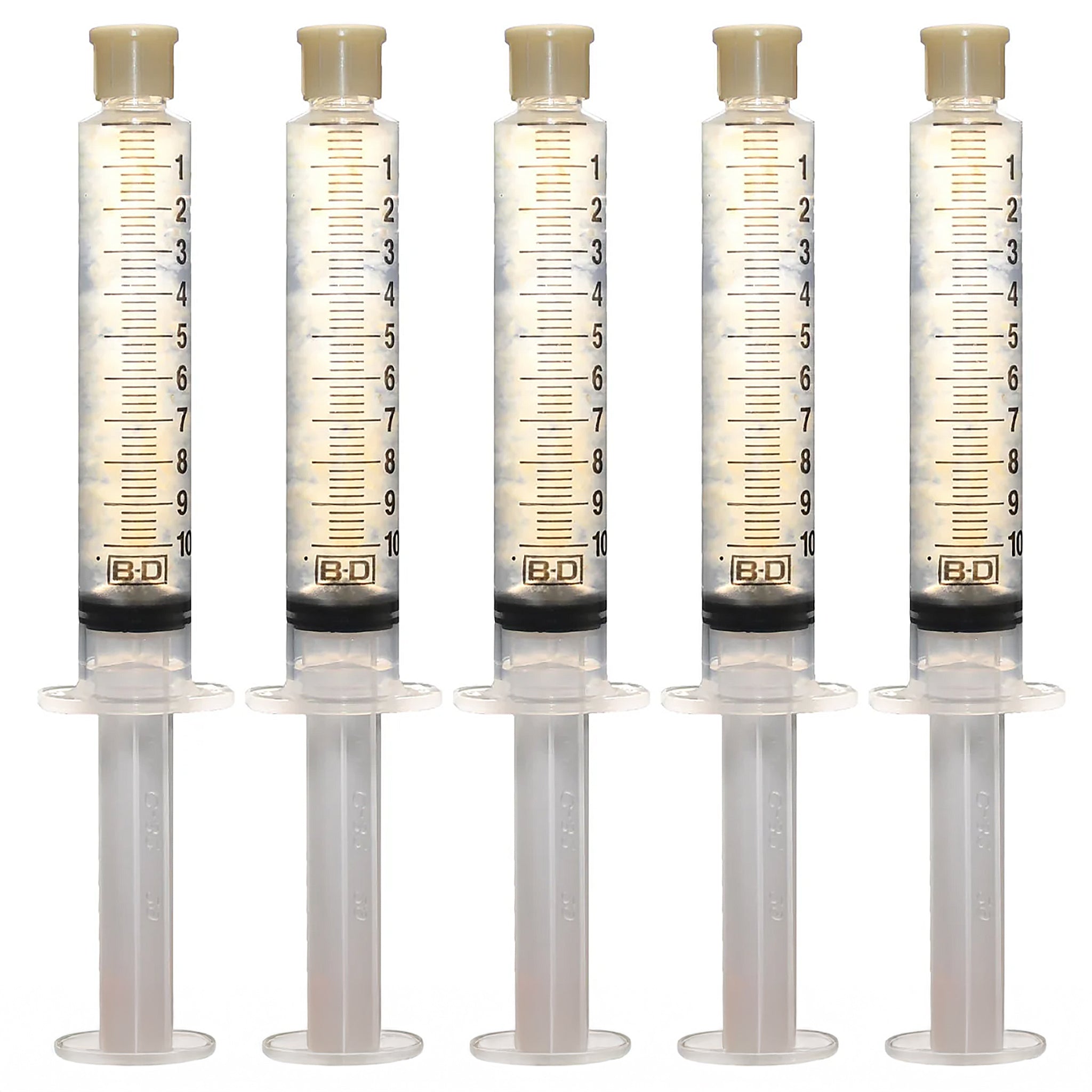
Our Jelly Fungi 5 Pack is a premium mushroom liquid culture: live, lab-verified mycelium suspended in sterile nutrient broth and ready to inoculate your grow medium. Each set ships with sterile needles for clean, reliable transfers.
Jelly Fungi Liquid Culture 5 Pack — Product Summary
- Five 10–12cc liquid culture syringes
- Includes: Judas Ear (Auricularia auricula-judae), Wood Ear (Auricularia fuscosuccinea), Snow Fungus (Tremella fuciformis), Apricot Jelly (Guepinia helvelloides), Fan Shaped Jelly (Dacryopinax spathularia)
- Each syringe contains viable mycelium in sterile nutrient broth
- Store liquid culture syringes at normal room temperature in the original packaging for 6 or more months.
- Ships with sterile needles
Jelly Fungi Liquid Culture 5 Pack — Pack Overview
The Jelly Fungi Mushroom Cultures 5 Pack brings together five of the most unusual and visually distinctive fungi we carry, a group that most cultivators have never worked with and many have never heard of. Jelly fungi are a polyphyletic group united by gelatinous or rubbery fruiting body texture rather than by close evolutionary relationship. Some of the five species in this pack are not even closely related to each other, which makes this collection genuinely educational from a mycological standpoint alongside being practically useful. Wood Ear and Judas Ear are the most commercially valuable jelly fungi in the world, widely used in Chinese and Japanese cuisine. The other three are genuine rarities in cultivation.
Jelly Fungi Liquid Culture 5 Pack — Included Species
Judas Ear (Auricularia auricula-judae) Liquid Culture
Judas Ear is the most commercially significant jelly fungus in the world. Auricularia auricula-judae is used throughout East Asian cuisine in hot and sour soup, stir fries, and cloud ear preparations, and it is one of the most produced mushroom species globally. The rubbery, ear-shaped fruiting bodies grow on elder wood in the wild and colonize hardwood substrate reliably in cultivation. We have sold this culture for years and it is one of the more forgiving species in this pack to work with.
Judas Ear — Out-Grow Lab Notes
| Parameter | Out-Grow Notes |
| Culture medium | LME + dextrose, 2% + 2% in distilled water |
| Substrate | Supplemented hardwood sawdust; elder and oak work particularly well |
| Fruiting temp | 55 to 75°F |
| Commercial significance | One of the most produced mushroom species globally; East Asian culinary staple |
| Inoculation rate | 2 to 3cc per quart of sterilized grain or hardwood substrate |
| Storage life | 6 or more months at normal room temperature |
Judas Ear Taxonomy
- Kingdom: Fungi
- Division: Basidiomycota
- Class: Agaricomycetes
- Order: Auriculariales
- Family: Auriculariaceae
- Genus: Auricularia
- Species: Auricularia auricula-judae
Wood Ear (Auricularia fuscosuccinea) Liquid Culture
Wood Ear is the warm-climate counterpart to Judas Ear, a tropical and subtropical Auricularia species that fruits at higher temperatures and on a wider range of hardwood species. In Chinese cuisine it is often used interchangeably with Judas Ear, but the two are distinct species with different temperature preferences. Wood Ear performs well in summer grows and warm indoor setups where Judas Ear may slow down.
Wood Ear — Out-Grow Lab Notes
| Parameter | Out-Grow Notes |
| Culture medium | LME + dextrose, 2% + 2% in distilled water |
| Substrate | Supplemented hardwood sawdust; performs on broader range of hardwoods than Judas Ear |
| Fruiting temp | 65 to 85°F — warmer preference than Judas Ear |
| Culinary use | Used interchangeably with Judas Ear in Chinese cuisine; distinct species |
| Inoculation rate | 2 to 3cc per quart of sterilized grain or hardwood substrate |
| Storage life | 6 or more months at normal room temperature |
Wood Ear Taxonomy
- Kingdom: Fungi
- Division: Basidiomycota
- Class: Agaricomycetes
- Order: Auriculariales
- Family: Auriculariaceae
- Genus: Auricularia
- Species: Auricularia fuscosuccinea
Snow Fungus (Tremella fuciformis) Liquid Culture
Snow Fungus is the white translucent jelly fungus used in Chinese cuisine and in skin care preparations for its polysaccharide content. Tremella fuciformis is technically a yeast parasite that requires a host fungus for full fruiting body development, which makes it the most complex cultivation project in this pack. We maintain it for researchers and specialty cultivators working on combined culture techniques.
Snow Fungus — Out-Grow Lab Notes
| Parameter | Out-Grow Notes |
| Culture medium | LME + dextrose, 2% + 2% in distilled water |
| Cultivation type | Mycoparasite — requires host fungus for fruiting body development |
| Best use | Research, combined culture experiments, specialty cultivation |
| Culinary use | Chinese dessert soups; skin care preparations |
| Inoculation rate | 2 to 3cc per quart of sterilized grain or hardwood substrate |
| Storage life | 6 or more months at normal room temperature |
Snow Fungus Taxonomy
- Kingdom: Fungi
- Division: Basidiomycota
- Class: Tremellomycetes
- Order: Tremellales
- Family: Tremellaceae
- Genus: Tremella
- Species: Tremella fuciformis
Apricot Jelly (Guepinia helvelloides) Liquid Culture
Apricot Jelly is one of the most visually striking fungi in our entire collection, a translucent salmon-orange to apricot colored jelly fungus that looks like something between a flower petal and a rubbery ear. Guepinia helvelloides grows in conifer duff and soil in temperate forests and is genuinely rare in cultivation. Most people who encounter it in the wild mistake it for something inedible. It is edible and mild in flavor. We carry this culture specifically because of its rarity in the cultivation market and its unusual visual character.
Apricot Jelly — Out-Grow Lab Notes
| Parameter | Out-Grow Notes |
| Culture medium | LME + dextrose, 2% + 2% in distilled water |
| Visual | Translucent salmon-apricot color — among the most visually unusual cultures we carry |
| Substrate | Conifer duff and soil; different from hardwood species |
| Rarity | Genuine rarity in the cultivation market |
| Inoculation rate | 2 to 3cc per quart of sterilized grain or hardwood substrate |
| Storage life | 6 or more months at normal room temperature |
Apricot Jelly Taxonomy
- Kingdom: Fungi
- Division: Basidiomycota
- Class: Dacrymycetes
- Order: Dacrymycetales
- Family: Dacrymycetaceae
- Genus: Guepinia
- Species: Guepinia helvelloides
Fan Shaped Jelly (Dacryopinax spathularia) Liquid Culture
Fan Shaped Jelly is a small orange jelly fungus that grows in dense colonies on wet or submerged conifer wood, producing fan-shaped or spatula-shaped fruiting bodies that are bright orange and distinctly unusual looking. Dacryopinax spathularia is in the Dacrymycetes class, making it evolutionarily distant from most other species in this pack despite the similar gelatinous texture. It is used in Chinese cuisine in some regions and is cultivated on wet conifer wood substrate.
Fan Shaped Jelly — Out-Grow Lab Notes
| Parameter | Out-Grow Notes |
| Culture medium | LME + dextrose, 2% + 2% in distilled water |
| Substrate | Wet or submerged conifer wood — different from hardwood cultivation |
| Visual | Dense colonies of bright orange fan-shaped fruiting bodies |
| Culinary use | Used in Chinese cuisine in some regions |
| Inoculation rate | 2 to 3cc per quart of sterilized grain or hardwood substrate |
| Storage life | 6 or more months at normal room temperature |
Fan Shaped Jelly Taxonomy
- Kingdom: Fungi
- Division: Basidiomycota
- Class: Dacrymycetes
- Order: Dacrymycetales
- Family: Dacrymycetaceae
- Genus: Dacryopinax
- Species: Dacryopinax spathularia
Jelly Fungi Liquid Culture 5 Pack — Cultivation Overview
The Jelly Fungi pack covers genuinely different cultivation approaches across five species. Judas Ear and Wood Ear are the most accessible on standard hardwood substrate. Snow Fungus requires a host fungus and is a specialty and research culture. Apricot Jelly and Fan Shaped Jelly require conifer substrate and are rare cultivation targets. All syringes ship from our McConnell, Illinois lab ready to inoculate.
Related Liquid Cultures & Collections
Jelly Fungi Liquid Culture 5 Pack | Mushroom Liquid Culture
Description
About This Mushroom Liquid Culture
Our Jelly Fungi 5 Pack is a premium mushroom liquid culture: live, lab-verified mycelium suspended in sterile nutrient broth and ready to inoculate your grow medium. Each set ships with sterile needles for clean, reliable transfers.
Jelly Fungi Liquid Culture 5 Pack — Product Summary
- Five 10–12cc liquid culture syringes
- Includes: Judas Ear (Auricularia auricula-judae), Wood Ear (Auricularia fuscosuccinea), Snow Fungus (Tremella fuciformis), Apricot Jelly (Guepinia helvelloides), Fan Shaped Jelly (Dacryopinax spathularia)
- Each syringe contains viable mycelium in sterile nutrient broth
- Store liquid culture syringes at normal room temperature in the original packaging for 6 or more months.
- Ships with sterile needles
Jelly Fungi Liquid Culture 5 Pack — Pack Overview
The Jelly Fungi Mushroom Cultures 5 Pack brings together five of the most unusual and visually distinctive fungi we carry, a group that most cultivators have never worked with and many have never heard of. Jelly fungi are a polyphyletic group united by gelatinous or rubbery fruiting body texture rather than by close evolutionary relationship. Some of the five species in this pack are not even closely related to each other, which makes this collection genuinely educational from a mycological standpoint alongside being practically useful. Wood Ear and Judas Ear are the most commercially valuable jelly fungi in the world, widely used in Chinese and Japanese cuisine. The other three are genuine rarities in cultivation.
Jelly Fungi Liquid Culture 5 Pack — Included Species
Judas Ear (Auricularia auricula-judae) Liquid Culture
Judas Ear is the most commercially significant jelly fungus in the world. Auricularia auricula-judae is used throughout East Asian cuisine in hot and sour soup, stir fries, and cloud ear preparations, and it is one of the most produced mushroom species globally. The rubbery, ear-shaped fruiting bodies grow on elder wood in the wild and colonize hardwood substrate reliably in cultivation. We have sold this culture for years and it is one of the more forgiving species in this pack to work with.
Judas Ear — Out-Grow Lab Notes
| Parameter | Out-Grow Notes |
| Culture medium | LME + dextrose, 2% + 2% in distilled water |
| Substrate | Supplemented hardwood sawdust; elder and oak work particularly well |
| Fruiting temp | 55 to 75°F |
| Commercial significance | One of the most produced mushroom species globally; East Asian culinary staple |
| Inoculation rate | 2 to 3cc per quart of sterilized grain or hardwood substrate |
| Storage life | 6 or more months at normal room temperature |
Judas Ear Taxonomy
- Kingdom: Fungi
- Division: Basidiomycota
- Class: Agaricomycetes
- Order: Auriculariales
- Family: Auriculariaceae
- Genus: Auricularia
- Species: Auricularia auricula-judae
Wood Ear (Auricularia fuscosuccinea) Liquid Culture
Wood Ear is the warm-climate counterpart to Judas Ear, a tropical and subtropical Auricularia species that fruits at higher temperatures and on a wider range of hardwood species. In Chinese cuisine it is often used interchangeably with Judas Ear, but the two are distinct species with different temperature preferences. Wood Ear performs well in summer grows and warm indoor setups where Judas Ear may slow down.
Wood Ear — Out-Grow Lab Notes
| Parameter | Out-Grow Notes |
| Culture medium | LME + dextrose, 2% + 2% in distilled water |
| Substrate | Supplemented hardwood sawdust; performs on broader range of hardwoods than Judas Ear |
| Fruiting temp | 65 to 85°F — warmer preference than Judas Ear |
| Culinary use | Used interchangeably with Judas Ear in Chinese cuisine; distinct species |
| Inoculation rate | 2 to 3cc per quart of sterilized grain or hardwood substrate |
| Storage life | 6 or more months at normal room temperature |
Wood Ear Taxonomy
- Kingdom: Fungi
- Division: Basidiomycota
- Class: Agaricomycetes
- Order: Auriculariales
- Family: Auriculariaceae
- Genus: Auricularia
- Species: Auricularia fuscosuccinea
Snow Fungus (Tremella fuciformis) Liquid Culture
Snow Fungus is the white translucent jelly fungus used in Chinese cuisine and in skin care preparations for its polysaccharide content. Tremella fuciformis is technically a yeast parasite that requires a host fungus for full fruiting body development, which makes it the most complex cultivation project in this pack. We maintain it for researchers and specialty cultivators working on combined culture techniques.
Snow Fungus — Out-Grow Lab Notes
| Parameter | Out-Grow Notes |
| Culture medium | LME + dextrose, 2% + 2% in distilled water |
| Cultivation type | Mycoparasite — requires host fungus for fruiting body development |
| Best use | Research, combined culture experiments, specialty cultivation |
| Culinary use | Chinese dessert soups; skin care preparations |
| Inoculation rate | 2 to 3cc per quart of sterilized grain or hardwood substrate |
| Storage life | 6 or more months at normal room temperature |
Snow Fungus Taxonomy
- Kingdom: Fungi
- Division: Basidiomycota
- Class: Tremellomycetes
- Order: Tremellales
- Family: Tremellaceae
- Genus: Tremella
- Species: Tremella fuciformis
Apricot Jelly (Guepinia helvelloides) Liquid Culture
Apricot Jelly is one of the most visually striking fungi in our entire collection, a translucent salmon-orange to apricot colored jelly fungus that looks like something between a flower petal and a rubbery ear. Guepinia helvelloides grows in conifer duff and soil in temperate forests and is genuinely rare in cultivation. Most people who encounter it in the wild mistake it for something inedible. It is edible and mild in flavor. We carry this culture specifically because of its rarity in the cultivation market and its unusual visual character.
Apricot Jelly — Out-Grow Lab Notes
| Parameter | Out-Grow Notes |
| Culture medium | LME + dextrose, 2% + 2% in distilled water |
| Visual | Translucent salmon-apricot color — among the most visually unusual cultures we carry |
| Substrate | Conifer duff and soil; different from hardwood species |
| Rarity | Genuine rarity in the cultivation market |
| Inoculation rate | 2 to 3cc per quart of sterilized grain or hardwood substrate |
| Storage life | 6 or more months at normal room temperature |
Apricot Jelly Taxonomy
- Kingdom: Fungi
- Division: Basidiomycota
- Class: Dacrymycetes
- Order: Dacrymycetales
- Family: Dacrymycetaceae
- Genus: Guepinia
- Species: Guepinia helvelloides
Fan Shaped Jelly (Dacryopinax spathularia) Liquid Culture
Fan Shaped Jelly is a small orange jelly fungus that grows in dense colonies on wet or submerged conifer wood, producing fan-shaped or spatula-shaped fruiting bodies that are bright orange and distinctly unusual looking. Dacryopinax spathularia is in the Dacrymycetes class, making it evolutionarily distant from most other species in this pack despite the similar gelatinous texture. It is used in Chinese cuisine in some regions and is cultivated on wet conifer wood substrate.
Fan Shaped Jelly — Out-Grow Lab Notes
| Parameter | Out-Grow Notes |
| Culture medium | LME + dextrose, 2% + 2% in distilled water |
| Substrate | Wet or submerged conifer wood — different from hardwood cultivation |
| Visual | Dense colonies of bright orange fan-shaped fruiting bodies |
| Culinary use | Used in Chinese cuisine in some regions |
| Inoculation rate | 2 to 3cc per quart of sterilized grain or hardwood substrate |
| Storage life | 6 or more months at normal room temperature |
Fan Shaped Jelly Taxonomy
- Kingdom: Fungi
- Division: Basidiomycota
- Class: Dacrymycetes
- Order: Dacrymycetales
- Family: Dacrymycetaceae
- Genus: Dacryopinax
- Species: Dacryopinax spathularia
Jelly Fungi Liquid Culture 5 Pack — Cultivation Overview
The Jelly Fungi pack covers genuinely different cultivation approaches across five species. Judas Ear and Wood Ear are the most accessible on standard hardwood substrate. Snow Fungus requires a host fungus and is a specialty and research culture. Apricot Jelly and Fan Shaped Jelly require conifer substrate and are rare cultivation targets. All syringes ship from our McConnell, Illinois lab ready to inoculate.