


Description
About This Mushroom Liquid Culture
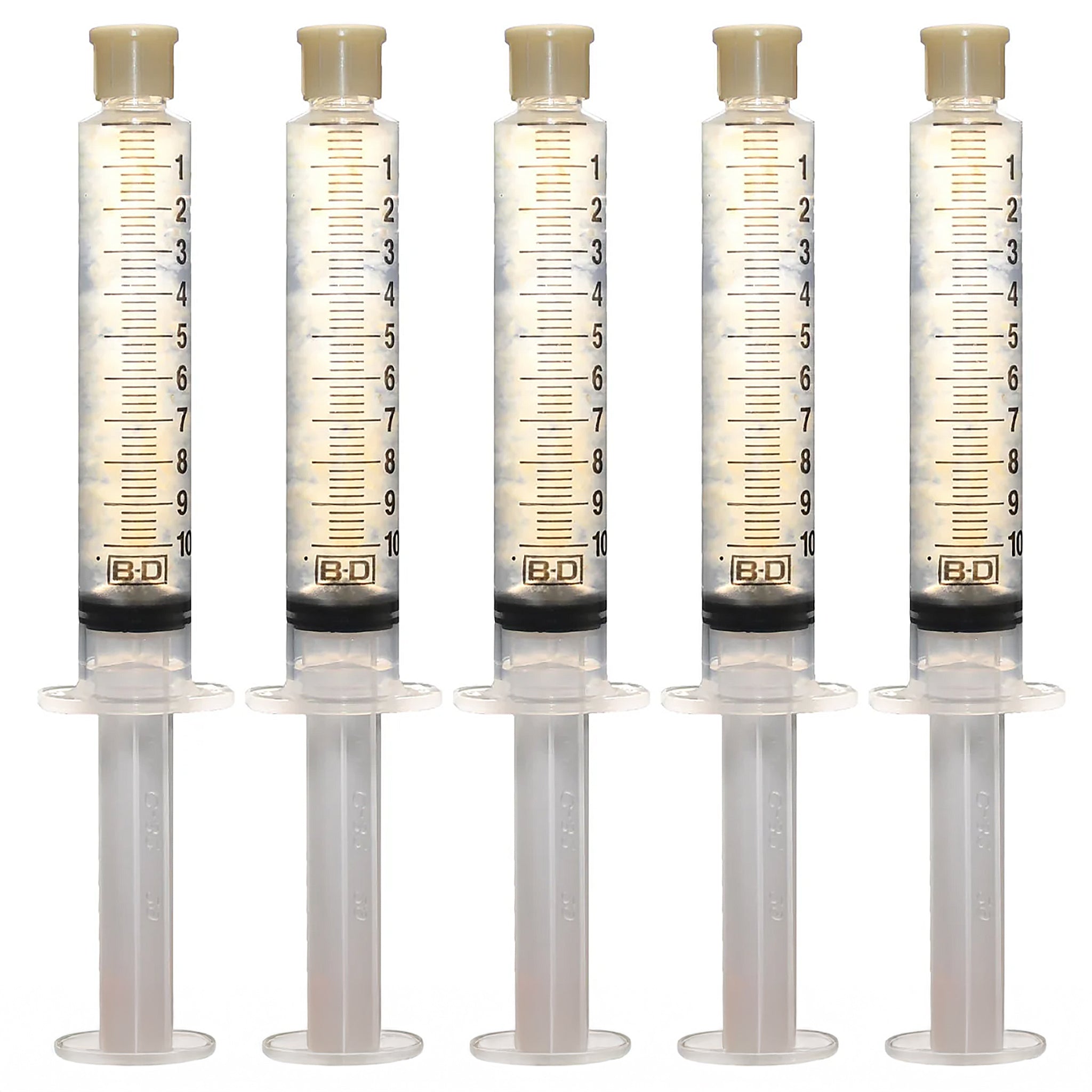
Our Morel 5 Pack is a premium mushroom liquid culture: live, lab-verified mycelium suspended in sterile nutrient broth and ready to inoculate your grow medium. Each set ships with sterile needles for clean, reliable transfers.
Morel Liquid Culture 5 Pack — Product Summary
- Five 10–12cc liquid culture syringes, each containing a distinct morel mushroom species
- Includes: Yellow Morel (Morchella esculenta), Black Morel (Morchella angusticeps), California Landscaping Morel (Morchella rufobrunnea), Morchella americana, and White Morel (Morchella deliciosa)
- Each morel liquid culture syringe contains viable mycelium suspended in a sterile nutrient broth
- Suitable for inoculating sterilized grain spawn, agar plates, and prepared outdoor soil beds
- Store liquid culture syringes at normal room temperature in the original packaging for 6 or more months.
- Ships with sterile needles
- All morel species require thorough cooking before consumption
Morel Liquid Culture 5 Pack — Pack Overview
The Morel Mushroom Liquid Culture 5 Pack includes five syringes, each containing a different morel species. Here at Out-Grow we have been selling morel mushroom liquid culture for many years and they have always been one of my favorite cultures we carry, for reasons that go well beyond their culinary and monetary value. The mycelium is dense and tough in a way that is distinct from most species I work with, and working with this genus on agar is genuinely different from any other mushroom. Morels have resisted reliable commercial cultivation longer than almost any edible mushroom on earth. This pack covers every major evolutionary branch of the genus Morchella. If you are serious about morel cultivation science or want verified cultures of five distinct species in one order, this is where you start.
Morel Liquid Culture 5 Pack — Included Species
Yellow Morel (Morchella esculenta) Liquid Culture
Yellow Morel is the spring morel most people picture when they hear the word morel. The honeycomb cap, the hollow stem, the brief season under hardwood trees each April. In Himalayan markets it sells dried for up to $620 per kilogram as Guchhi. I mention that not as a pitch but because it explains why so many people want to grow it and why it has defeated serious cultivation attempts for decades. We produce this culture on our standard light malt extract and dextrose medium and it establishes reliably within the first week. The thing I watch for with yellow morel on grain is sclerotia formation. When you start seeing those compact orange-brown bodies developing in the colonized substrate, that is the signal you are working with a viable culture and heading in the right direction for outdoor bed work.
Yellow Morel — Out-Grow Lab Notes
| Parameter | Out-Grow Notes |
| Culture medium | LME + dextrose, 2% + 2% in distilled water |
| Syringe appearance | Faint white hyphal threads in clear to pale amber broth |
| Sclerotia formation | Forms on depleted agar and grain; the viability indicator we look for |
| Inoculation rate | 2 to 3cc per quart of sterilized grain |
| Storage life | 6 or more months at normal room temperature |
| Indoor fruiting | None established — outdoor bed cultivation is the viable pathway |
Yellow Morel Taxonomy
- Kingdom: Fungi
- Division: Ascomycota
- Class: Pezizomycetes
- Order: Pezizales
- Family: Morchellaceae
- Genus: Morchella
- Species: Morchella esculenta
Black Morel (Morchella angusticeps) Liquid Culture
Black Morel is the morel most people in the eastern United States are actually hunting in the woods each spring. It fruits under white ash, green ash, and tulip tree from the Appalachians through the Midwest, and its ridges darken to true black as the fruiting body matures. Something worth knowing before you buy black morel liquid culture from anyone: a lot of what gets sold under that name is actually Morchella importuna, the Chinese commercial cultivation species. That is a different organism. What we carry here is Morchella angusticeps, the eastern North American wild type. We produce it on our standard LME and dextrose base. One thing I have noticed over multiple production runs is that MEA supplemented with coconut water does a better job pushing sclerotia formation than plain media, and the published research on morel agar culture supports that, with sclerotia appearing in 9 to 12 days under those conditions.
Black Morel — Out-Grow Lab Notes
| Parameter | Out-Grow Notes |
| Culture medium | LME + dextrose 2% + 2%; MEA + coconut water recommended for agar sclerotia work |
| Sclerotia timeline | 9 to 12 days on MEA + coconut water; slower on plain media |
| Species note | Morchella angusticeps — eastern North American wild type, not M. importuna |
| Inoculation rate | 2 to 3cc per quart of sterilized rye or wheat berries |
| Storage life | 6 or more months at normal room temperature |
| Indoor fruiting | None established — requires outdoor methodology and winter chilling hours |
Black Morel Taxonomy
- Kingdom: Fungi
- Division: Ascomycota
- Class: Pezizomycetes
- Order: Pezizales
- Family: Morchellaceae
- Genus: Morchella
- Species: Morchella angusticeps
California Landscaping Morel (Morchella rufobrunnea) Liquid Culture
The California Landscaping Morel is the most cultivatable morel species we carry and the only true morel with peer-reviewed indoor fruiting documentation. What most people do not know is that the entire body of morel cultivation science, including the Ower patents from the 1980s and the Gourmet Mushrooms commercial operation, was built on this species even though researchers thought they were working with Morchella esculenta at the time. Molecular work clarified the identity decades later. It is a true saprotroph, which is exactly why indoor cultivation is biologically possible here when it stays out of reach for the yellow and black morel clades. In the lab the mycelium has a fine tomentose texture I find distinctive after years of working with it, and it bruises reddish-orange wherever the tissue is touched. Getting sclerotia to fully melanize from white through rust to brown before any induction attempt is the step most people rush. It is not optional.
California Landscaping Morel — Out-Grow Lab Notes
| Parameter | Out-Grow Notes |
| Culture medium | LME + dextrose, 2% + 2% in distilled water |
| Visual ID | Bruises reddish-orange on contact — the reliable identification character |
| Sclerotia timeline | Approximately 3 weeks; white to rust to brown melanization required before induction |
| Indoor fruiting | Documented — only morel in this pack with a published indoor protocol |
| Inoculation rate | 2 to 3cc per quart of sterilized grain for spawn production |
| Storage life | 6 or more months at normal room temperature |
California Landscaping Morel Taxonomy
- Kingdom: Fungi
- Division: Ascomycota
- Class: Pezizomycetes
- Order: Pezizales
- Family: Morchellaceae
- Genus: Morchella
- Species: Morchella rufobrunnea
Morchella americana Liquid Culture
Morchella americana is the yellow morel most people in North America are actually finding in the field, even though field guides called it Morchella esculenta for generations. The name changed in 2012 when molecular work confirmed North American populations are genetically distinct from the European species. We carry both separately because they are different organisms and serious cultivators should have access to both with accurate labeling. In the lab the mycelium looks light tan to near-white with a tomentose texture on agar. What I pay attention to with this culture specifically is surface sclerotia formation as the colony ages. Seeing those compact bodies tells you the culture is healthy. One thing worth knowing going into outdoor bed work: this species is likely heterothallic, meaning a culture from a single tissue isolate carries only one mating type. That does not affect agar work or grain spawn production at all, but it is useful context if outdoor bed results fall short of expectations.
Morchella americana — Out-Grow Lab Notes
| Parameter | Out-Grow Notes |
| Culture medium | LME + dextrose, 2% + 2% in distilled water |
| Species note | The actual yellow morel of eastern North America; distinct from European M. esculenta |
| Mating type note | Likely heterothallic — relevant context for outdoor fruiting experiments |
| Inoculation rate | 2 to 3cc per quart of sterilized grain |
| Storage life | 6 or more months at normal room temperature |
| Indoor fruiting | None established — multi-season outdoor methodology is the pathway |
Morchella americana Taxonomy
- Kingdom: Fungi
- Division: Ascomycota
- Class: Pezizomycetes
- Order: Pezizales
- Family: Morchellaceae
- Genus: Morchella
- Species: Morchella americana
White Morel (Morchella deliciosa) Liquid Culture
White Morel is the pale-capped spring morel of European forests, distinct from the yellow morel group by molecular work and by the noticeably paler coloring of the cap ridges. Morchella deliciosa sits in the Esculenta Clade and shares the same cultivation approach as the other yellow morel relatives in this pack. Foragers who find it in European forests rate it among the finest morels for table quality. In the lab it behaves similarly to the other Esculenta Clade cultures, forming white to cream tomentose mycelium on agar and producing sclerotia on depleted media. We run it on the same LME and dextrose medium we use across the genus.
White Morel — Out-Grow Lab Notes
| Parameter | Out-Grow Notes |
| Culture medium | LME + dextrose, 2% + 2% in distilled water |
| Agar appearance | White to cream, tomentose; sclerotia form on depleted media |
| Inoculation rate | 2 to 3cc per quart of sterilized grain |
| Storage life | 6 or more months at normal room temperature |
| Indoor fruiting | None established — outdoor bed cultivation near hardwood hosts |
White Morel Taxonomy
- Kingdom: Fungi
- Division: Ascomycota
- Class: Pezizomycetes
- Order: Pezizales
- Family: Morchellaceae
- Genus: Morchella
- Species: Morchella deliciosa
Morel Liquid Culture 5 Pack — Cultivation Overview
One thing I tell every customer who asks about morel liquid culture before they order: morel cultivation is not a standard mushroom grow. The workflow that works for oyster or shiitake does not apply here. Morel mycelium has to produce sclerotia first, and that step requires the right substrate conditions, not just healthy mycelium. The California Landscaping Morel is the one species in this pack with a documented indoor fruiting pathway. The other four are serious outdoor cultivation and research cultures, and we say that plainly because you should know it before you start. All syringes ship from our McConnell, Illinois lab ready to inoculate.
Related Liquid Cultures & Collections
Morel Liquid Culture 5 Pack | Mushroom Liquid Culture
Description
About This Mushroom Liquid Culture
Our Morel 5 Pack is a premium mushroom liquid culture: live, lab-verified mycelium suspended in sterile nutrient broth and ready to inoculate your grow medium. Each set ships with sterile needles for clean, reliable transfers.
Morel Liquid Culture 5 Pack — Product Summary
- Five 10–12cc liquid culture syringes, each containing a distinct morel mushroom species
- Includes: Yellow Morel (Morchella esculenta), Black Morel (Morchella angusticeps), California Landscaping Morel (Morchella rufobrunnea), Morchella americana, and White Morel (Morchella deliciosa)
- Each morel liquid culture syringe contains viable mycelium suspended in a sterile nutrient broth
- Suitable for inoculating sterilized grain spawn, agar plates, and prepared outdoor soil beds
- Store liquid culture syringes at normal room temperature in the original packaging for 6 or more months.
- Ships with sterile needles
- All morel species require thorough cooking before consumption
Morel Liquid Culture 5 Pack — Pack Overview
The Morel Mushroom Liquid Culture 5 Pack includes five syringes, each containing a different morel species. Here at Out-Grow we have been selling morel mushroom liquid culture for many years and they have always been one of my favorite cultures we carry, for reasons that go well beyond their culinary and monetary value. The mycelium is dense and tough in a way that is distinct from most species I work with, and working with this genus on agar is genuinely different from any other mushroom. Morels have resisted reliable commercial cultivation longer than almost any edible mushroom on earth. This pack covers every major evolutionary branch of the genus Morchella. If you are serious about morel cultivation science or want verified cultures of five distinct species in one order, this is where you start.
Morel Liquid Culture 5 Pack — Included Species
Yellow Morel (Morchella esculenta) Liquid Culture
Yellow Morel is the spring morel most people picture when they hear the word morel. The honeycomb cap, the hollow stem, the brief season under hardwood trees each April. In Himalayan markets it sells dried for up to $620 per kilogram as Guchhi. I mention that not as a pitch but because it explains why so many people want to grow it and why it has defeated serious cultivation attempts for decades. We produce this culture on our standard light malt extract and dextrose medium and it establishes reliably within the first week. The thing I watch for with yellow morel on grain is sclerotia formation. When you start seeing those compact orange-brown bodies developing in the colonized substrate, that is the signal you are working with a viable culture and heading in the right direction for outdoor bed work.
Yellow Morel — Out-Grow Lab Notes
| Parameter | Out-Grow Notes |
| Culture medium | LME + dextrose, 2% + 2% in distilled water |
| Syringe appearance | Faint white hyphal threads in clear to pale amber broth |
| Sclerotia formation | Forms on depleted agar and grain; the viability indicator we look for |
| Inoculation rate | 2 to 3cc per quart of sterilized grain |
| Storage life | 6 or more months at normal room temperature |
| Indoor fruiting | None established — outdoor bed cultivation is the viable pathway |
Yellow Morel Taxonomy
- Kingdom: Fungi
- Division: Ascomycota
- Class: Pezizomycetes
- Order: Pezizales
- Family: Morchellaceae
- Genus: Morchella
- Species: Morchella esculenta
Black Morel (Morchella angusticeps) Liquid Culture
Black Morel is the morel most people in the eastern United States are actually hunting in the woods each spring. It fruits under white ash, green ash, and tulip tree from the Appalachians through the Midwest, and its ridges darken to true black as the fruiting body matures. Something worth knowing before you buy black morel liquid culture from anyone: a lot of what gets sold under that name is actually Morchella importuna, the Chinese commercial cultivation species. That is a different organism. What we carry here is Morchella angusticeps, the eastern North American wild type. We produce it on our standard LME and dextrose base. One thing I have noticed over multiple production runs is that MEA supplemented with coconut water does a better job pushing sclerotia formation than plain media, and the published research on morel agar culture supports that, with sclerotia appearing in 9 to 12 days under those conditions.
Black Morel — Out-Grow Lab Notes
| Parameter | Out-Grow Notes |
| Culture medium | LME + dextrose 2% + 2%; MEA + coconut water recommended for agar sclerotia work |
| Sclerotia timeline | 9 to 12 days on MEA + coconut water; slower on plain media |
| Species note | Morchella angusticeps — eastern North American wild type, not M. importuna |
| Inoculation rate | 2 to 3cc per quart of sterilized rye or wheat berries |
| Storage life | 6 or more months at normal room temperature |
| Indoor fruiting | None established — requires outdoor methodology and winter chilling hours |
Black Morel Taxonomy
- Kingdom: Fungi
- Division: Ascomycota
- Class: Pezizomycetes
- Order: Pezizales
- Family: Morchellaceae
- Genus: Morchella
- Species: Morchella angusticeps
California Landscaping Morel (Morchella rufobrunnea) Liquid Culture
The California Landscaping Morel is the most cultivatable morel species we carry and the only true morel with peer-reviewed indoor fruiting documentation. What most people do not know is that the entire body of morel cultivation science, including the Ower patents from the 1980s and the Gourmet Mushrooms commercial operation, was built on this species even though researchers thought they were working with Morchella esculenta at the time. Molecular work clarified the identity decades later. It is a true saprotroph, which is exactly why indoor cultivation is biologically possible here when it stays out of reach for the yellow and black morel clades. In the lab the mycelium has a fine tomentose texture I find distinctive after years of working with it, and it bruises reddish-orange wherever the tissue is touched. Getting sclerotia to fully melanize from white through rust to brown before any induction attempt is the step most people rush. It is not optional.
California Landscaping Morel — Out-Grow Lab Notes
| Parameter | Out-Grow Notes |
| Culture medium | LME + dextrose, 2% + 2% in distilled water |
| Visual ID | Bruises reddish-orange on contact — the reliable identification character |
| Sclerotia timeline | Approximately 3 weeks; white to rust to brown melanization required before induction |
| Indoor fruiting | Documented — only morel in this pack with a published indoor protocol |
| Inoculation rate | 2 to 3cc per quart of sterilized grain for spawn production |
| Storage life | 6 or more months at normal room temperature |
California Landscaping Morel Taxonomy
- Kingdom: Fungi
- Division: Ascomycota
- Class: Pezizomycetes
- Order: Pezizales
- Family: Morchellaceae
- Genus: Morchella
- Species: Morchella rufobrunnea
Morchella americana Liquid Culture
Morchella americana is the yellow morel most people in North America are actually finding in the field, even though field guides called it Morchella esculenta for generations. The name changed in 2012 when molecular work confirmed North American populations are genetically distinct from the European species. We carry both separately because they are different organisms and serious cultivators should have access to both with accurate labeling. In the lab the mycelium looks light tan to near-white with a tomentose texture on agar. What I pay attention to with this culture specifically is surface sclerotia formation as the colony ages. Seeing those compact bodies tells you the culture is healthy. One thing worth knowing going into outdoor bed work: this species is likely heterothallic, meaning a culture from a single tissue isolate carries only one mating type. That does not affect agar work or grain spawn production at all, but it is useful context if outdoor bed results fall short of expectations.
Morchella americana — Out-Grow Lab Notes
| Parameter | Out-Grow Notes |
| Culture medium | LME + dextrose, 2% + 2% in distilled water |
| Species note | The actual yellow morel of eastern North America; distinct from European M. esculenta |
| Mating type note | Likely heterothallic — relevant context for outdoor fruiting experiments |
| Inoculation rate | 2 to 3cc per quart of sterilized grain |
| Storage life | 6 or more months at normal room temperature |
| Indoor fruiting | None established — multi-season outdoor methodology is the pathway |
Morchella americana Taxonomy
- Kingdom: Fungi
- Division: Ascomycota
- Class: Pezizomycetes
- Order: Pezizales
- Family: Morchellaceae
- Genus: Morchella
- Species: Morchella americana
White Morel (Morchella deliciosa) Liquid Culture
White Morel is the pale-capped spring morel of European forests, distinct from the yellow morel group by molecular work and by the noticeably paler coloring of the cap ridges. Morchella deliciosa sits in the Esculenta Clade and shares the same cultivation approach as the other yellow morel relatives in this pack. Foragers who find it in European forests rate it among the finest morels for table quality. In the lab it behaves similarly to the other Esculenta Clade cultures, forming white to cream tomentose mycelium on agar and producing sclerotia on depleted media. We run it on the same LME and dextrose medium we use across the genus.
White Morel — Out-Grow Lab Notes
| Parameter | Out-Grow Notes |
| Culture medium | LME + dextrose, 2% + 2% in distilled water |
| Agar appearance | White to cream, tomentose; sclerotia form on depleted media |
| Inoculation rate | 2 to 3cc per quart of sterilized grain |
| Storage life | 6 or more months at normal room temperature |
| Indoor fruiting | None established — outdoor bed cultivation near hardwood hosts |
White Morel Taxonomy
- Kingdom: Fungi
- Division: Ascomycota
- Class: Pezizomycetes
- Order: Pezizales
- Family: Morchellaceae
- Genus: Morchella
- Species: Morchella deliciosa
Morel Liquid Culture 5 Pack — Cultivation Overview
One thing I tell every customer who asks about morel liquid culture before they order: morel cultivation is not a standard mushroom grow. The workflow that works for oyster or shiitake does not apply here. Morel mycelium has to produce sclerotia first, and that step requires the right substrate conditions, not just healthy mycelium. The California Landscaping Morel is the one species in this pack with a documented indoor fruiting pathway. The other four are serious outdoor cultivation and research cultures, and we say that plainly because you should know it before you start. All syringes ship from our McConnell, Illinois lab ready to inoculate.