


Description
What is the Pheasant Back Mushroom?
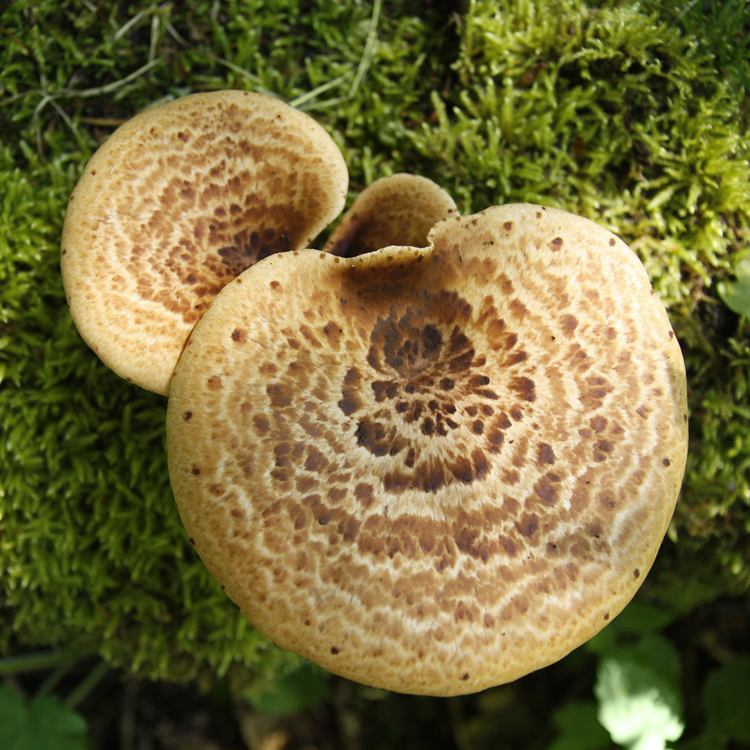
The Pheasant Back Mushroom (Polyporus squamosus), also known as Dryad's Saddle, is a striking bracket fungus found on deciduous trees across the Northern Hemisphere. Its common name comes from the bold brown scales arranged in concentric rings on the cap surface — a pattern that closely resembles the feathering of a pheasant's back. The name Dryad's Saddle references its saddle-like shape and association with woodland trees.
It is one of the earliest polypores to appear each spring, often fruiting while the forest floor is still cool and moist, making it a welcome find for foragers. Young, tender specimens are edible with a mild, melon-like aroma — older specimens become tough, corky, and strongly fragrant, and are better suited to drying and powdering for use as a seasoning or broth base.
Where Does Polyporus squamosus Grow?
Polyporus squamosus is a white-rot saprotroph and opportunistic parasite, growing on dead, dying, or wounded hardwood trees. It favors elm, ash, sycamore, poplar, willow, walnut, and maple, though it will colonize a wide range of deciduous species. In North America it is widespread east of the Rocky Mountains; in Europe it is common throughout temperate broadleaf woodlands. It typically appears from late spring through early summer, with a second smaller flush possible in autumn.
Fruiting bodies emerge as fan-shaped to kidney-shaped brackets, 10–60 cm across, with a thick off-center stem. Young brackets are soft and cream-white underneath; mature specimens harden to a fibrous, tough consistency and develop a distinctly watermelon-rind odor that becomes increasingly pronounced with age.
Cultivation and Liquid Culture Use
Polyporus squamosus can be grown on sterilized hardwood sawdust and wood chip substrates — elm, oak, and beech all work well. Mycelial colonization is relatively straightforward, but achieving fruiting bodies in controlled indoor conditions is challenging due to the species' preference for the cool, moist conditions of late spring. Outdoor log inoculation, particularly on freshly cut elm or ash logs, offers the most reliable pathway to fruiting body production.
This liquid culture contains clean, viable Polyporus squamosus mycelium ready for inoculating sterilized grain spawn, hardwood sawdust blocks, or agar plates. It is well suited to experimental cultivation trials, log inoculation programs, and culture collection work.
Taxonomic Details for Polyporus squamosus
- Kingdom: Fungi
- Division: Basidiomycota
- Class: Agaricomycetes
- Order: Polyporales
- Family: Polyporaceae
- Genus: Polyporus
- Species: Polyporus squamosus
Pheasant Back Mushroom (Polyporus squamosus) Liquid Culture Syringe
Product Overview
Ideal Conditions
Cultivation Tips
Storage
Edibility
Safety and Disclaimer
Description
What is the Pheasant Back Mushroom?
The Pheasant Back Mushroom (Polyporus squamosus), also known as Dryad's Saddle, is a striking bracket fungus found on deciduous trees across the Northern Hemisphere. Its common name comes from the bold brown scales arranged in concentric rings on the cap surface — a pattern that closely resembles the feathering of a pheasant's back. The name Dryad's Saddle references its saddle-like shape and association with woodland trees.
It is one of the earliest polypores to appear each spring, often fruiting while the forest floor is still cool and moist, making it a welcome find for foragers. Young, tender specimens are edible with a mild, melon-like aroma — older specimens become tough, corky, and strongly fragrant, and are better suited to drying and powdering for use as a seasoning or broth base.
Where Does Polyporus squamosus Grow?
Polyporus squamosus is a white-rot saprotroph and opportunistic parasite, growing on dead, dying, or wounded hardwood trees. It favors elm, ash, sycamore, poplar, willow, walnut, and maple, though it will colonize a wide range of deciduous species. In North America it is widespread east of the Rocky Mountains; in Europe it is common throughout temperate broadleaf woodlands. It typically appears from late spring through early summer, with a second smaller flush possible in autumn.
Fruiting bodies emerge as fan-shaped to kidney-shaped brackets, 10–60 cm across, with a thick off-center stem. Young brackets are soft and cream-white underneath; mature specimens harden to a fibrous, tough consistency and develop a distinctly watermelon-rind odor that becomes increasingly pronounced with age.
Cultivation and Liquid Culture Use
Polyporus squamosus can be grown on sterilized hardwood sawdust and wood chip substrates — elm, oak, and beech all work well. Mycelial colonization is relatively straightforward, but achieving fruiting bodies in controlled indoor conditions is challenging due to the species' preference for the cool, moist conditions of late spring. Outdoor log inoculation, particularly on freshly cut elm or ash logs, offers the most reliable pathway to fruiting body production.
This liquid culture contains clean, viable Polyporus squamosus mycelium ready for inoculating sterilized grain spawn, hardwood sawdust blocks, or agar plates. It is well suited to experimental cultivation trials, log inoculation programs, and culture collection work.
Taxonomic Details for Polyporus squamosus
- Kingdom: Fungi
- Division: Basidiomycota
- Class: Agaricomycetes
- Order: Polyporales
- Family: Polyporaceae
- Genus: Polyporus
- Species: Polyporus squamosus