


Description
About This Mushroom Liquid Culture
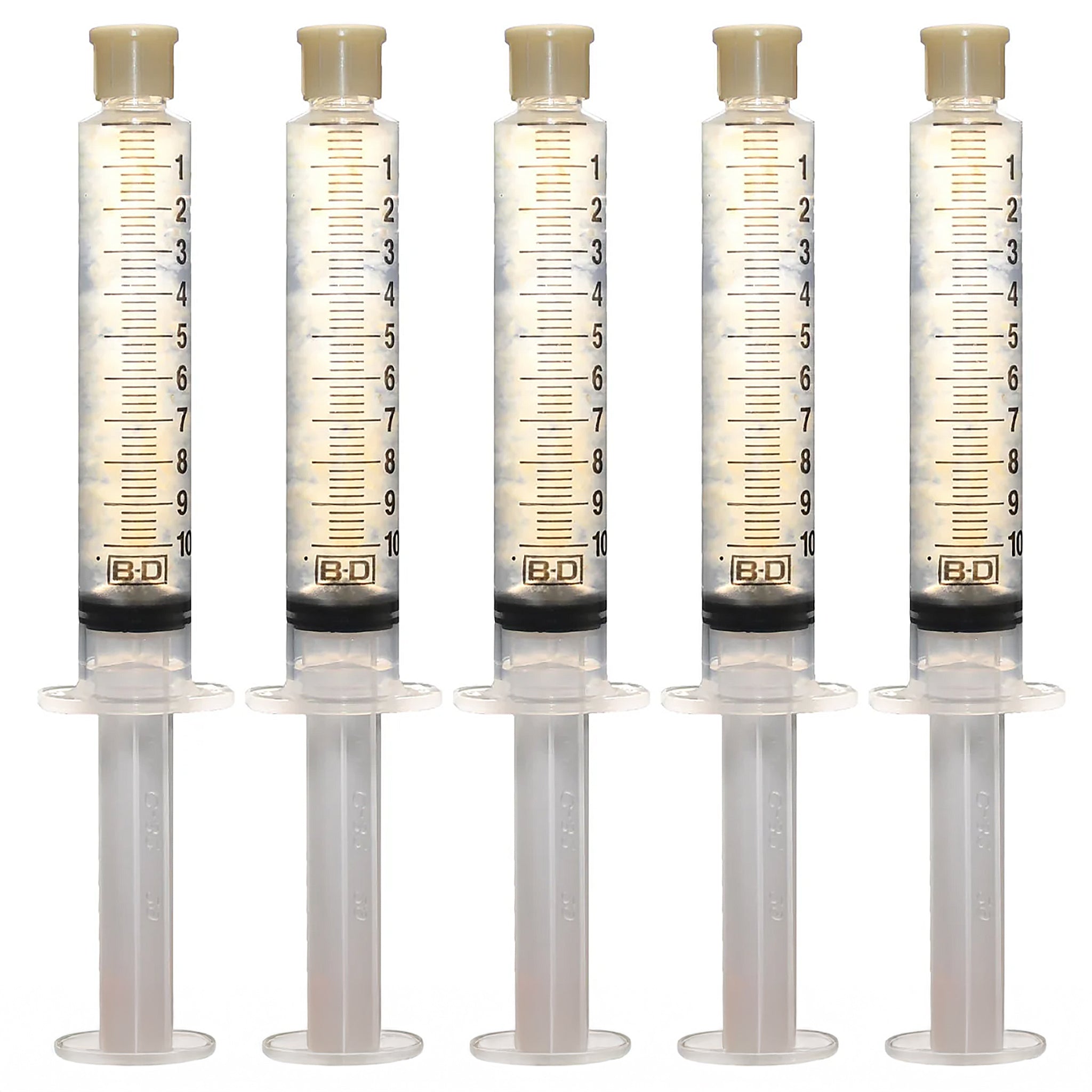
Our Mycorestoration 5 Pack is a premium mushroom liquid culture: live, lab-verified mycelium suspended in sterile nutrient broth and ready to inoculate your grow medium. Each set ships with sterile needles for clean, reliable transfers.
Mycorestoration Liquid Culture 5 Pack — Product Summary
- Five 10–12cc liquid culture syringes
- Includes: Pestalotiopsis microspora, Phanerochaete chrysosporium, Turkey Tail (Trametes versicolor), Blue Oyster (Pleurotus columbinus), Giant Puffball (Calvatia gigantea)
- Each syringe contains viable mycelium in sterile nutrient broth
- Store liquid culture syringes at normal room temperature in the original packaging for 6 or more months.
- Ships with sterile needles
Mycorestoration Liquid Culture 5 Pack — Pack Overview
The Mycorestoration Mushroom Cultures 5 Pack combines specialized bioremediation fungi with highly productive saprotrophic species, covering the full range of what applied mycology looks like in environmental restoration contexts. Mycorestoration uses fungal mycelium to break down contaminants, stabilize disturbed soils, reduce runoff, and support ecosystem recovery. This pack gives practitioners access to both the specialized degradation species and the productive saprotrophs that build soil structure and mycelial networks in restoration sites.
Mycorestoration Liquid Culture 5 Pack — Included Species
Pestalotiopsis microspora Liquid Culture
Pestalotiopsis microspora is included here for its documented polyurethane degradation capability, the bioremediation application most relevant to contaminated site restoration involving petroleum-derived plastics and synthetic compounds.
Pestalotiopsis microspora — Out-Grow Lab Notes
| Parameter | Out-Grow Notes |
| Culture medium | LME + dextrose, 2% + 2% in distilled water |
| Application | Synthetic compound degradation; relevant to contaminated site restoration |
| Inoculation rate | 2 to 3cc per quart of sterilized grain or hardwood substrate |
| Storage life | 6 or more months at normal room temperature |
Pestalotiopsis microspora Taxonomy
- Kingdom: Fungi
- Division: Ascomycota
- Class: Sordariomycetes
- Order: Amphisphaeriales
- Family: Sporocadaceae
- Genus: Pestalotiopsis
- Species: Pestalotiopsis microspora
Phanerochaete chrysosporium Liquid Culture
Phanerochaete chrysosporium is the most studied white rot fungus for ligninolytic enzyme production and persistent organic pollutant degradation. It is the workhorse bioremediation species that restoration practitioners reach for first when dealing with PAH and chlorinated compound contamination.
Phanerochaete chrysosporium — Out-Grow Lab Notes
| Parameter | Out-Grow Notes |
| Culture medium | LME + dextrose, 2% + 2% in distilled water |
| Application | PAH and chlorinated compound degradation; persistent organic pollutant remediation |
| Inoculation rate | 2 to 3cc per quart of sterilized grain or hardwood substrate |
| Storage life | 6 or more months at normal room temperature |
Phanerochaete chrysosporium Taxonomy
- Kingdom: Fungi
- Division: Basidiomycota
- Class: Agaricomycetes
- Order: Polyporales
- Family: Phanerochaetaceae
- Genus: Phanerochaete
- Species: Phanerochaete chrysosporium
Turkey Tail (Trametes versicolor) Liquid Culture
Turkey Tail is one of the better documented bioremediation species among the edible and medicinal mushrooms, with capacity to degrade petroleum compounds and heavy metal accumulation from contaminated substrate. It colonizes hardwood aggressively and is one of the first species to colonize disturbed forest sites naturally.
Turkey Tail — Out-Grow Lab Notes
| Parameter | Out-Grow Notes |
| Culture medium | LME + dextrose, 2% + 2% in distilled water |
| Restoration value | Colonizes disturbed sites naturally; documented petroleum compound degradation |
| Additional value | Edible and medicinal species — dual use in restoration contexts |
| Inoculation rate | 2 to 3cc per quart of sterilized grain or hardwood substrate |
| Storage life | 6 or more months at normal room temperature |
Turkey Tail Taxonomy
- Kingdom: Fungi
- Division: Basidiomycota
- Class: Agaricomycetes
- Order: Polyporales
- Family: Polyporaceae
- Genus: Trametes
- Species: Trametes versicolor
Blue Oyster (Pleurotus columbinus) Liquid Culture
Pleurotus species including blue oyster have been extensively studied for mycoremediation applications, particularly petroleum hydrocarbon degradation. Blue oyster's aggressive colonization and broad substrate tolerance make it a practical choice for restoration practitioners establishing mycelial networks in disturbed sites.
Blue Oyster — Out-Grow Lab Notes
| Parameter | Out-Grow Notes |
| Culture medium | LME + dextrose, 2% + 2% in distilled water |
| Restoration value | Petroleum hydrocarbon degradation; broad substrate tolerance for disturbed sites |
| Practicality | Aggressive colonizer — reliable establishment in restoration contexts |
| Inoculation rate | 2 to 3cc per quart of sterilized grain or hardwood substrate |
| Storage life | 6 or more months at normal room temperature |
Blue Oyster Taxonomy
- Kingdom: Fungi
- Division: Basidiomycota
- Class: Agaricomycetes
- Order: Agaricales
- Family: Pleurotaceae
- Genus: Pleurotus
- Species: Pleurotus columbinus
Giant Puffball (Calvatia gigantea) Liquid Culture
Giant Puffball contributes deep saprotrophic mycelial networks to restoration sites, helping build soil organic matter and support the microbial community structure that disturbed sites need to recover. It establishes in open meadow and edge habitats that often characterize remediation sites.
Giant Puffball — Out-Grow Lab Notes
| Parameter | Out-Grow Notes |
| Culture medium | LME + dextrose, 2% + 2% in distilled water |
| Restoration value | Deep saprotrophic mycelial networks; soil organic matter building |
| Habitat | Open meadows and edge habitats — common remediation site types |
| Inoculation rate | 2 to 3cc per quart of sterilized grain or hardwood substrate |
| Storage life | 6 or more months at normal room temperature |
Giant Puffball Taxonomy
- Kingdom: Fungi
- Division: Basidiomycota
- Class: Agaricomycetes
- Order: Agaricales
- Family: Agaricaceae
- Genus: Calvatia
- Species: Calvatia gigantea
Mycorestoration Liquid Culture 5 Pack — Cultivation Overview
The Mycorestoration pack serves environmental practitioners, researchers, and ecological restoration professionals. The two specialized bioremediation species are research and application cultures. The three saprotrophic species can be cultivated conventionally and applied to restoration sites as grain spawn. All syringes ship from our McConnell, Illinois lab ready to inoculate.
Related Liquid Cultures & Collections
Mycorestoration Liquid Culture 5 Pack | Mushroom Liquid Culture
Description
About This Mushroom Liquid Culture
Our Mycorestoration 5 Pack is a premium mushroom liquid culture: live, lab-verified mycelium suspended in sterile nutrient broth and ready to inoculate your grow medium. Each set ships with sterile needles for clean, reliable transfers.
Mycorestoration Liquid Culture 5 Pack — Product Summary
- Five 10–12cc liquid culture syringes
- Includes: Pestalotiopsis microspora, Phanerochaete chrysosporium, Turkey Tail (Trametes versicolor), Blue Oyster (Pleurotus columbinus), Giant Puffball (Calvatia gigantea)
- Each syringe contains viable mycelium in sterile nutrient broth
- Store liquid culture syringes at normal room temperature in the original packaging for 6 or more months.
- Ships with sterile needles
Mycorestoration Liquid Culture 5 Pack — Pack Overview
The Mycorestoration Mushroom Cultures 5 Pack combines specialized bioremediation fungi with highly productive saprotrophic species, covering the full range of what applied mycology looks like in environmental restoration contexts. Mycorestoration uses fungal mycelium to break down contaminants, stabilize disturbed soils, reduce runoff, and support ecosystem recovery. This pack gives practitioners access to both the specialized degradation species and the productive saprotrophs that build soil structure and mycelial networks in restoration sites.
Mycorestoration Liquid Culture 5 Pack — Included Species
Pestalotiopsis microspora Liquid Culture
Pestalotiopsis microspora is included here for its documented polyurethane degradation capability, the bioremediation application most relevant to contaminated site restoration involving petroleum-derived plastics and synthetic compounds.
Pestalotiopsis microspora — Out-Grow Lab Notes
| Parameter | Out-Grow Notes |
| Culture medium | LME + dextrose, 2% + 2% in distilled water |
| Application | Synthetic compound degradation; relevant to contaminated site restoration |
| Inoculation rate | 2 to 3cc per quart of sterilized grain or hardwood substrate |
| Storage life | 6 or more months at normal room temperature |
Pestalotiopsis microspora Taxonomy
- Kingdom: Fungi
- Division: Ascomycota
- Class: Sordariomycetes
- Order: Amphisphaeriales
- Family: Sporocadaceae
- Genus: Pestalotiopsis
- Species: Pestalotiopsis microspora
Phanerochaete chrysosporium Liquid Culture
Phanerochaete chrysosporium is the most studied white rot fungus for ligninolytic enzyme production and persistent organic pollutant degradation. It is the workhorse bioremediation species that restoration practitioners reach for first when dealing with PAH and chlorinated compound contamination.
Phanerochaete chrysosporium — Out-Grow Lab Notes
| Parameter | Out-Grow Notes |
| Culture medium | LME + dextrose, 2% + 2% in distilled water |
| Application | PAH and chlorinated compound degradation; persistent organic pollutant remediation |
| Inoculation rate | 2 to 3cc per quart of sterilized grain or hardwood substrate |
| Storage life | 6 or more months at normal room temperature |
Phanerochaete chrysosporium Taxonomy
- Kingdom: Fungi
- Division: Basidiomycota
- Class: Agaricomycetes
- Order: Polyporales
- Family: Phanerochaetaceae
- Genus: Phanerochaete
- Species: Phanerochaete chrysosporium
Turkey Tail (Trametes versicolor) Liquid Culture
Turkey Tail is one of the better documented bioremediation species among the edible and medicinal mushrooms, with capacity to degrade petroleum compounds and heavy metal accumulation from contaminated substrate. It colonizes hardwood aggressively and is one of the first species to colonize disturbed forest sites naturally.
Turkey Tail — Out-Grow Lab Notes
| Parameter | Out-Grow Notes |
| Culture medium | LME + dextrose, 2% + 2% in distilled water |
| Restoration value | Colonizes disturbed sites naturally; documented petroleum compound degradation |
| Additional value | Edible and medicinal species — dual use in restoration contexts |
| Inoculation rate | 2 to 3cc per quart of sterilized grain or hardwood substrate |
| Storage life | 6 or more months at normal room temperature |
Turkey Tail Taxonomy
- Kingdom: Fungi
- Division: Basidiomycota
- Class: Agaricomycetes
- Order: Polyporales
- Family: Polyporaceae
- Genus: Trametes
- Species: Trametes versicolor
Blue Oyster (Pleurotus columbinus) Liquid Culture
Pleurotus species including blue oyster have been extensively studied for mycoremediation applications, particularly petroleum hydrocarbon degradation. Blue oyster's aggressive colonization and broad substrate tolerance make it a practical choice for restoration practitioners establishing mycelial networks in disturbed sites.
Blue Oyster — Out-Grow Lab Notes
| Parameter | Out-Grow Notes |
| Culture medium | LME + dextrose, 2% + 2% in distilled water |
| Restoration value | Petroleum hydrocarbon degradation; broad substrate tolerance for disturbed sites |
| Practicality | Aggressive colonizer — reliable establishment in restoration contexts |
| Inoculation rate | 2 to 3cc per quart of sterilized grain or hardwood substrate |
| Storage life | 6 or more months at normal room temperature |
Blue Oyster Taxonomy
- Kingdom: Fungi
- Division: Basidiomycota
- Class: Agaricomycetes
- Order: Agaricales
- Family: Pleurotaceae
- Genus: Pleurotus
- Species: Pleurotus columbinus
Giant Puffball (Calvatia gigantea) Liquid Culture
Giant Puffball contributes deep saprotrophic mycelial networks to restoration sites, helping build soil organic matter and support the microbial community structure that disturbed sites need to recover. It establishes in open meadow and edge habitats that often characterize remediation sites.
Giant Puffball — Out-Grow Lab Notes
| Parameter | Out-Grow Notes |
| Culture medium | LME + dextrose, 2% + 2% in distilled water |
| Restoration value | Deep saprotrophic mycelial networks; soil organic matter building |
| Habitat | Open meadows and edge habitats — common remediation site types |
| Inoculation rate | 2 to 3cc per quart of sterilized grain or hardwood substrate |
| Storage life | 6 or more months at normal room temperature |
Giant Puffball Taxonomy
- Kingdom: Fungi
- Division: Basidiomycota
- Class: Agaricomycetes
- Order: Agaricales
- Family: Agaricaceae
- Genus: Calvatia
- Species: Calvatia gigantea
Mycorestoration Liquid Culture 5 Pack — Cultivation Overview
The Mycorestoration pack serves environmental practitioners, researchers, and ecological restoration professionals. The two specialized bioremediation species are research and application cultures. The three saprotrophic species can be cultivated conventionally and applied to restoration sites as grain spawn. All syringes ship from our McConnell, Illinois lab ready to inoculate.