


Description
About This Mushroom Liquid Culture
Our Wild Edible 5 Pack is a premium mushroom liquid culture: live, lab-verified mycelium suspended in sterile nutrient broth and ready to inoculate your grow medium. Each set ships with sterile needles for clean, reliable transfers.
Wild Edible Liquid Culture 5 Pack — Product Summary
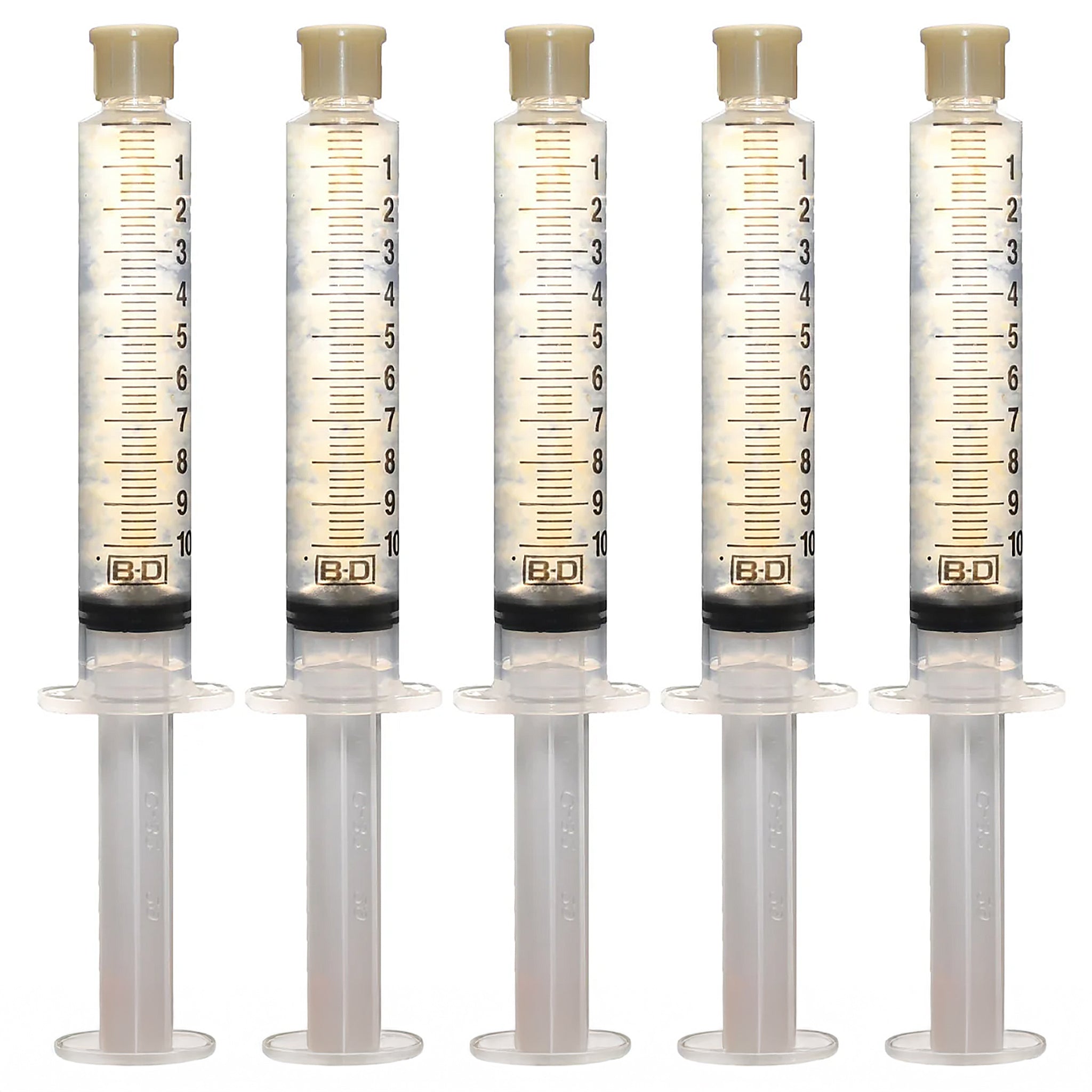
- Five 10–12cc liquid culture syringes, each containing a distinct wild edible species
- Includes: Blewit (Lepista nuda), Blue Chanterelle (Polyozellus multiplex), Cinnamon Cap (Hypholoma sublateritium), Birch Polypore (Piptoporus betulinus), Berkeley's Polypore (Bondarzewia berkeleyi)
- Each syringe contains viable mycelium suspended in a sterile nutrient broth
- Species vary in substrate requirements — see individual cultivation notes below
- Store liquid culture syringes at normal room temperature in the original packaging for 6 or more months.
- Ships with sterile needles
Wild Edible Liquid Culture 5 Pack — Pack Overview
The Wild Edible Mushroom Cultures 5 Pack brings together five species that serious foragers and collectors know well but that rarely appear in the standard liquid culture catalog. Blewit, Blue Chanterelle, Cinnamon Cap, Birch Polypore, and Berkeley's Polypore are all genuinely edible fungi with distinct flavors, ecological roles, and cultivation requirements. None of these are beginner species — they each require specific substrate conditions or environmental cues — but for cultivators who have worked through the common oysters and shiitakes and want to grow something unusual and genuinely their own, this pack covers five species that most suppliers do not carry at all.
Wild Edible Liquid Culture 5 Pack — Included Species
Blewit Mushroom (Lepista nuda) Liquid Culture
Lepista nuda, commonly known as Blewit or Wood Blewit, is a distinctive saprotrophic agaric found across temperate Europe and North America, typically fruiting in leaf litter and compost-rich woodland soils in autumn and early winter. It produces medium to large fruiting bodies with a lilac to violet coloration that fades with age, and a firm, dense cap with a pleasant mild flavor and faint floral aroma. Blewit is a cold-tolerant species that fruits late in the season when most other mushrooms have finished. In cultivation, it performs well on composted substrates — leaf mold, straw, and aged manure-based mixes — and benefits from outdoor or cold-room conditions during fruiting. It does not colonize hardwood sawdust like oyster mushrooms and requires a different cultivation approach.
Blewit Mushroom (Lepista nuda) Cultivation Parameters
| Parameter | Range |
| Culture medium | LME + dextrose, 2% + 2% in distilled water |
| Incubation Temperature | 65°F – 75°F |
| Incubation Time | 21 – 35 days |
| Fruiting Temperature | 45°F – 60°F |
| Fruiting Humidity | 80% – 90% |
| Substrate | Composted leaf mold, aged straw, manure-based mix |
| Storage life | 6 or more months at normal room temperature |
Blue Chanterelle (Polyozellus multiplex) Liquid Culture
Polyozellus multiplex, the Blue Chanterelle or Black Chanterelle, is a rare ectomycorrhizal fungus native to coniferous forests of North America and eastern Asia. It produces densely clustered, deeply pigmented fruiting bodies ranging from steel blue to near-black, with a false-gill or smooth undersurface rather than true gills. Blue Chanterelle is among the most visually unusual edible fungi in North American forests and is rarely encountered even by experienced foragers. As an ectomycorrhizal species it forms obligate symbiotic relationships with living conifer roots, which means it cannot be fruited conventionally from substrate — this culture is maintained for research, agar work, and mycorrhizal inoculation projects rather than standard indoor cultivation.
Blue Chanterelle (Polyozellus multiplex) Cultivation Parameters
| Parameter | Range |
| Culture medium | LME + dextrose, 2% + 2% in distilled water |
| Culture Use | Agar work, mycorrhizal inoculation, research |
| Host Requirement | Living conifer roots (ectomycorrhizal) |
| Indoor Fruiting | Not possible without live host |
| Storage life | 6 or more months at normal room temperature |
Cinnamon Cap Mushroom (Hypholoma sublateritium) Liquid Culture
Hypholoma sublateritium, commonly known as Cinnamon Cap or Brick Cap, is a wood-decaying saprophyte that grows in dense clusters on dead hardwood stumps and logs across temperate North America, Europe, and Asia, typically fruiting in autumn. It produces medium-sized, brick-red to cinnamon-brown caps with yellow-green gills and a firm, dense texture. Cinnamon Cap is a late-season species that fruits when temperatures drop in autumn and is cold-tolerant enough to continue producing into early winter in some climates. In cultivation it colonizes supplemented hardwood sawdust and benefits from a cold initiation period to trigger pinning. It is a genuinely edible species with a mild, slightly bitter flavor that diminishes with cooking.
Cinnamon Cap Mushroom (Hypholoma sublateritium) Cultivation Parameters
| Parameter | Range |
| Culture medium | LME + dextrose, 2% + 2% in distilled water |
| Incubation Temperature | 65°F – 75°F |
| Incubation Time | 21 – 35 days |
| Fruiting Temperature | 50°F – 65°F |
| Fruiting Humidity | 85% – 95% |
| Substrate | Supplemented hardwood sawdust, hardwood logs |
| Storage life | 6 or more months at normal room temperature |
Birch Polypore (Piptoporus betulinus) Liquid Culture
Piptoporus betulinus, the Birch Polypore, is a wood-decaying bracket fungus found exclusively on dead and dying birch trees across temperate forests worldwide. It produces smooth, kidney-shaped, pale tan to white fruiting bodies with a distinctive smooth upper surface and fine pores underneath. Birch Polypore has been used medicinally for thousands of years — it was found among the possessions of Otzi the Iceman — and has attracted modern research interest for its bioactive compound profile. While technically edible it is too tough and bitter for culinary use, making it primarily a medicinal and research culture. It colonizes birch-based substrates and sawdust but does not fruit reliably under standard indoor conditions.
Birch Polypore (Piptoporus betulinus) Cultivation Parameters
| Parameter | Range |
| Culture medium | LME + dextrose, 2% + 2% in distilled water |
| Incubation Temperature | 65°F – 75°F |
| Incubation Time | 30 – 60 days |
| Fruiting | Birch wood or birch sawdust; outdoor log preferred |
| Primary Use | Medicinal research, agar work, extract production |
| Storage life | 6 or more months at normal room temperature |
Berkeley's Polypore (Bondarzewia berkeleyi) Liquid Culture
Bondarzewia berkeleyi, commonly known as Berkeley's Polypore, is a large terrestrial polypore that fruits at the base of hardwood trees — particularly oak — across eastern North America and parts of Asia. It produces massive, overlapping rosettes of pale tan to cream-colored caps that can reach impressive sizes in mature stands. Berkeley's Polypore is a prized edible when harvested young and tender, with a mild, slightly sweet flavor and a firm texture that holds up well to cooking. As it matures it becomes tough and bitter, so harvest timing is important. In cultivation it colonizes supplemented hardwood sawdust and requires outdoor log or stump establishment for reliable fruiting, similar to maitake methodology.
Berkeley's Polypore (Bondarzewia berkeleyi) Cultivation Parameters
| Parameter | Range |
| Culture medium | LME + dextrose, 2% + 2% in distilled water |
| Incubation Temperature | 70°F – 80°F |
| Incubation Time | 30 – 60 days |
| Fruiting Method | Outdoor hardwood log or stump inoculation |
| Fruiting Temperature | 65°F – 80°F |
| Substrate | Oak logs, stumps, supplemented hardwood sawdust |
| Storage life | 6 or more months at normal room temperature |
Wild Edible Liquid Culture 5 Pack — Cultivation Overview
Liquid culture syringes contain living mycelium suspended in a sterile solution of water and dissolved nutrients. Each syringe in the Wild Edible Mushroom Cultures 5 Pack is prepared from isolated cultures. Blewit and Cinnamon Cap require composted or hardwood substrates respectively and cold fruiting conditions. Blue Chanterelle is an ectomycorrhizal species suitable for mycorrhizal inoculation and agar work rather than standard indoor fruiting. Birch Polypore colonizes birch-based substrates and is best suited to outdoor log projects and research applications. Berkeley's Polypore is best established on outdoor oak logs or stumps following maitake-style methodology. All syringes ship from our McConnell, Illinois lab ready to inoculate.
Wild Edible Liquid Culture 5 Pack — Taxonomy
Blewit Mushroom (Lepista nuda) Taxonomy
- Kingdom: Fungi
- Division: Basidiomycota
- Class: Agaricomycetes
- Order: Agaricales
- Family: Tricholomataceae
- Genus: Lepista
- Species: Lepista nuda
Blue Chanterelle (Polyozellus multiplex) Taxonomy
- Kingdom: Fungi
- Division: Basidiomycota
- Class: Agaricomycetes
- Order: Thelephorales
- Family: Thelephoraceae
- Genus: Polyozellus
- Species: Polyozellus multiplex
Cinnamon Cap Mushroom (Hypholoma sublateritium) Taxonomy
- Kingdom: Fungi
- Division: Basidiomycota
- Class: Agaricomycetes
- Order: Agaricales
- Family: Strophariaceae
- Genus: Hypholoma
- Species: Hypholoma sublateritium
Birch Polypore (Piptoporus betulinus) Taxonomy
- Kingdom: Fungi
- Division: Basidiomycota
- Class: Agaricomycetes
- Order: Polyporales
- Family: Fomitopsidaceae
- Genus: Piptoporus
- Species: Piptoporus betulinus
Berkeley's Polypore (Bondarzewia berkeleyi) Taxonomy
- Kingdom: Fungi
- Division: Basidiomycota
- Class: Agaricomycetes
- Order: Russulales
- Family: Bondarzewiaceae
- Genus: Bondarzewia
- Species: Bondarzewia berkeleyi
Related Liquid Cultures & Collections
Wild Edible Liquid Culture 5 Pack | Mushroom Liquid Culture
Description
About This Mushroom Liquid Culture
Our Wild Edible 5 Pack is a premium mushroom liquid culture: live, lab-verified mycelium suspended in sterile nutrient broth and ready to inoculate your grow medium. Each set ships with sterile needles for clean, reliable transfers.
Wild Edible Liquid Culture 5 Pack — Product Summary
- Five 10–12cc liquid culture syringes, each containing a distinct wild edible species
- Includes: Blewit (Lepista nuda), Blue Chanterelle (Polyozellus multiplex), Cinnamon Cap (Hypholoma sublateritium), Birch Polypore (Piptoporus betulinus), Berkeley's Polypore (Bondarzewia berkeleyi)
- Each syringe contains viable mycelium suspended in a sterile nutrient broth
- Species vary in substrate requirements — see individual cultivation notes below
- Store liquid culture syringes at normal room temperature in the original packaging for 6 or more months.
- Ships with sterile needles
Wild Edible Liquid Culture 5 Pack — Pack Overview
The Wild Edible Mushroom Cultures 5 Pack brings together five species that serious foragers and collectors know well but that rarely appear in the standard liquid culture catalog. Blewit, Blue Chanterelle, Cinnamon Cap, Birch Polypore, and Berkeley's Polypore are all genuinely edible fungi with distinct flavors, ecological roles, and cultivation requirements. None of these are beginner species — they each require specific substrate conditions or environmental cues — but for cultivators who have worked through the common oysters and shiitakes and want to grow something unusual and genuinely their own, this pack covers five species that most suppliers do not carry at all.
Wild Edible Liquid Culture 5 Pack — Included Species
Blewit Mushroom (Lepista nuda) Liquid Culture
Lepista nuda, commonly known as Blewit or Wood Blewit, is a distinctive saprotrophic agaric found across temperate Europe and North America, typically fruiting in leaf litter and compost-rich woodland soils in autumn and early winter. It produces medium to large fruiting bodies with a lilac to violet coloration that fades with age, and a firm, dense cap with a pleasant mild flavor and faint floral aroma. Blewit is a cold-tolerant species that fruits late in the season when most other mushrooms have finished. In cultivation, it performs well on composted substrates — leaf mold, straw, and aged manure-based mixes — and benefits from outdoor or cold-room conditions during fruiting. It does not colonize hardwood sawdust like oyster mushrooms and requires a different cultivation approach.
Blewit Mushroom (Lepista nuda) Cultivation Parameters
| Parameter | Range |
| Culture medium | LME + dextrose, 2% + 2% in distilled water |
| Incubation Temperature | 65°F – 75°F |
| Incubation Time | 21 – 35 days |
| Fruiting Temperature | 45°F – 60°F |
| Fruiting Humidity | 80% – 90% |
| Substrate | Composted leaf mold, aged straw, manure-based mix |
| Storage life | 6 or more months at normal room temperature |
Blue Chanterelle (Polyozellus multiplex) Liquid Culture
Polyozellus multiplex, the Blue Chanterelle or Black Chanterelle, is a rare ectomycorrhizal fungus native to coniferous forests of North America and eastern Asia. It produces densely clustered, deeply pigmented fruiting bodies ranging from steel blue to near-black, with a false-gill or smooth undersurface rather than true gills. Blue Chanterelle is among the most visually unusual edible fungi in North American forests and is rarely encountered even by experienced foragers. As an ectomycorrhizal species it forms obligate symbiotic relationships with living conifer roots, which means it cannot be fruited conventionally from substrate — this culture is maintained for research, agar work, and mycorrhizal inoculation projects rather than standard indoor cultivation.
Blue Chanterelle (Polyozellus multiplex) Cultivation Parameters
| Parameter | Range |
| Culture medium | LME + dextrose, 2% + 2% in distilled water |
| Culture Use | Agar work, mycorrhizal inoculation, research |
| Host Requirement | Living conifer roots (ectomycorrhizal) |
| Indoor Fruiting | Not possible without live host |
| Storage life | 6 or more months at normal room temperature |
Cinnamon Cap Mushroom (Hypholoma sublateritium) Liquid Culture
Hypholoma sublateritium, commonly known as Cinnamon Cap or Brick Cap, is a wood-decaying saprophyte that grows in dense clusters on dead hardwood stumps and logs across temperate North America, Europe, and Asia, typically fruiting in autumn. It produces medium-sized, brick-red to cinnamon-brown caps with yellow-green gills and a firm, dense texture. Cinnamon Cap is a late-season species that fruits when temperatures drop in autumn and is cold-tolerant enough to continue producing into early winter in some climates. In cultivation it colonizes supplemented hardwood sawdust and benefits from a cold initiation period to trigger pinning. It is a genuinely edible species with a mild, slightly bitter flavor that diminishes with cooking.
Cinnamon Cap Mushroom (Hypholoma sublateritium) Cultivation Parameters
| Parameter | Range |
| Culture medium | LME + dextrose, 2% + 2% in distilled water |
| Incubation Temperature | 65°F – 75°F |
| Incubation Time | 21 – 35 days |
| Fruiting Temperature | 50°F – 65°F |
| Fruiting Humidity | 85% – 95% |
| Substrate | Supplemented hardwood sawdust, hardwood logs |
| Storage life | 6 or more months at normal room temperature |
Birch Polypore (Piptoporus betulinus) Liquid Culture
Piptoporus betulinus, the Birch Polypore, is a wood-decaying bracket fungus found exclusively on dead and dying birch trees across temperate forests worldwide. It produces smooth, kidney-shaped, pale tan to white fruiting bodies with a distinctive smooth upper surface and fine pores underneath. Birch Polypore has been used medicinally for thousands of years — it was found among the possessions of Otzi the Iceman — and has attracted modern research interest for its bioactive compound profile. While technically edible it is too tough and bitter for culinary use, making it primarily a medicinal and research culture. It colonizes birch-based substrates and sawdust but does not fruit reliably under standard indoor conditions.
Birch Polypore (Piptoporus betulinus) Cultivation Parameters
| Parameter | Range |
| Culture medium | LME + dextrose, 2% + 2% in distilled water |
| Incubation Temperature | 65°F – 75°F |
| Incubation Time | 30 – 60 days |
| Fruiting | Birch wood or birch sawdust; outdoor log preferred |
| Primary Use | Medicinal research, agar work, extract production |
| Storage life | 6 or more months at normal room temperature |
Berkeley's Polypore (Bondarzewia berkeleyi) Liquid Culture
Bondarzewia berkeleyi, commonly known as Berkeley's Polypore, is a large terrestrial polypore that fruits at the base of hardwood trees — particularly oak — across eastern North America and parts of Asia. It produces massive, overlapping rosettes of pale tan to cream-colored caps that can reach impressive sizes in mature stands. Berkeley's Polypore is a prized edible when harvested young and tender, with a mild, slightly sweet flavor and a firm texture that holds up well to cooking. As it matures it becomes tough and bitter, so harvest timing is important. In cultivation it colonizes supplemented hardwood sawdust and requires outdoor log or stump establishment for reliable fruiting, similar to maitake methodology.
Berkeley's Polypore (Bondarzewia berkeleyi) Cultivation Parameters
| Parameter | Range |
| Culture medium | LME + dextrose, 2% + 2% in distilled water |
| Incubation Temperature | 70°F – 80°F |
| Incubation Time | 30 – 60 days |
| Fruiting Method | Outdoor hardwood log or stump inoculation |
| Fruiting Temperature | 65°F – 80°F |
| Substrate | Oak logs, stumps, supplemented hardwood sawdust |
| Storage life | 6 or more months at normal room temperature |
Wild Edible Liquid Culture 5 Pack — Cultivation Overview
Liquid culture syringes contain living mycelium suspended in a sterile solution of water and dissolved nutrients. Each syringe in the Wild Edible Mushroom Cultures 5 Pack is prepared from isolated cultures. Blewit and Cinnamon Cap require composted or hardwood substrates respectively and cold fruiting conditions. Blue Chanterelle is an ectomycorrhizal species suitable for mycorrhizal inoculation and agar work rather than standard indoor fruiting. Birch Polypore colonizes birch-based substrates and is best suited to outdoor log projects and research applications. Berkeley's Polypore is best established on outdoor oak logs or stumps following maitake-style methodology. All syringes ship from our McConnell, Illinois lab ready to inoculate.
Wild Edible Liquid Culture 5 Pack — Taxonomy
Blewit Mushroom (Lepista nuda) Taxonomy
- Kingdom: Fungi
- Division: Basidiomycota
- Class: Agaricomycetes
- Order: Agaricales
- Family: Tricholomataceae
- Genus: Lepista
- Species: Lepista nuda
Blue Chanterelle (Polyozellus multiplex) Taxonomy
- Kingdom: Fungi
- Division: Basidiomycota
- Class: Agaricomycetes
- Order: Thelephorales
- Family: Thelephoraceae
- Genus: Polyozellus
- Species: Polyozellus multiplex
Cinnamon Cap Mushroom (Hypholoma sublateritium) Taxonomy
- Kingdom: Fungi
- Division: Basidiomycota
- Class: Agaricomycetes
- Order: Agaricales
- Family: Strophariaceae
- Genus: Hypholoma
- Species: Hypholoma sublateritium
Birch Polypore (Piptoporus betulinus) Taxonomy
- Kingdom: Fungi
- Division: Basidiomycota
- Class: Agaricomycetes
- Order: Polyporales
- Family: Fomitopsidaceae
- Genus: Piptoporus
- Species: Piptoporus betulinus
Berkeley's Polypore (Bondarzewia berkeleyi) Taxonomy
- Kingdom: Fungi
- Division: Basidiomycota
- Class: Agaricomycetes
- Order: Russulales
- Family: Bondarzewiaceae
- Genus: Bondarzewia
- Species: Bondarzewia berkeleyi